Can a Netanyahu Defeat Change Israel's War Strategy?
Oct 30, 2026, 19:41 IST
Summary
The debate surrounding Israel's elections centers on whether a potential defeat of Prime Minister Netanyahu could alter the nation's approach to the ongoing conflict. Dr. Qamar Cheema argues that election outcomes will not change violence in Gaza or the West Bank, while Khanversation highlights the role of Arab parties as kingmakers, asserting that fundamental policy changes are unlikely regardless of leadership.
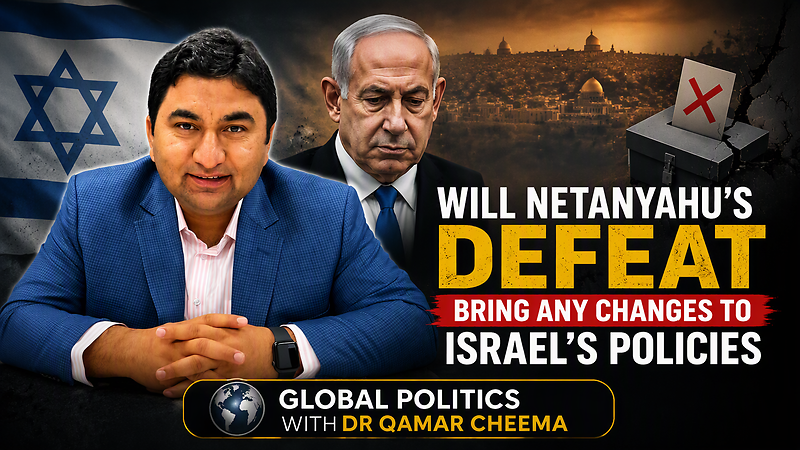
As Israel approaches its elections, the question of whether a potential defeat for Prime Minister Benjamin Netanyahu could alter the nation's approach to the ongoing conflict with Palestinians is a hotly debated topic among commentators. The perspectives vary significantly, with some arguing that a change in leadership would have little to no impact on policies, while others suggest it could influence Israel's geopolitical strategies.
Global politics commentator Dr. Qamar Cheema argues that the outcome of the elections will not change the violent status quo in Gaza or the West Bank. He claims, 'Israeli election results will not change Gaza or West Bank violence,' suggesting that regardless of who wins, the entrenched issues will persist. Cheema does acknowledge that a Netanyahu defeat might lessen Israeli pressure on the United States regarding another conflict with Iran. However, he warns that even if Netanyahu were to lose, he could remain in power temporarily, stating, 'Netanyahu could remain interim prime minister and escalate war after losing.' Thus, he concludes that there is 'nothing positive coming out of the Israeli election.'
Adding another layer to this discussion, the popular YouTube channel Khanversation emphasizes the role of Arab parties in the elections. They note that the Joint List and Ra’am are projected to win around 19 Knesset seats, positioning them as potential kingmakers. They argue, 'This result would not materially change Israel’s political situation,' reinforcing the sentiment that even a shift in leadership may not lead to significant policy changes.
Khanversation also discusses Netanyahu's strategic delays in calling for elections, suggesting that he has been leveraging geopolitical tensions to bolster his campaign. They claim, 'Netanyahu used geopolitical tensions and war as electoral campaign tools,' and highlight that he may have even violated Iranian airspace to provoke conflict ahead of the elections. This assertion raises questions about whether Netanyahu's strategies are more about maintaining power than genuinely altering Israel's approach to the conflict.
Echoing similar sentiments, another Khanversation segment states that regardless of who leads, policies towards the West Bank and Gaza are unlikely to change. They assert, 'Israel will remain a genocidal apartheid state regardless of who takes power,' emphasizing the continuity of human rights violations and systemic issues that plague the region. This perspective aligns closely with Cheema's view on the unchanging nature of the Israeli-Palestinian conflict.
In summary, while some voices express hope that a Netanyahu defeat could lead to shifts in Israel's foreign policy, the consensus among various commentators suggests that fundamental changes are unlikely. The intertwined nature of political dynamics and historical grievances indicates that the elections may serve more as a reflection of existing tensions rather than a catalyst for transformative change in Israel's approach to the conflict.