China's Rise and India's Challenge: Can India Catch Up?
Sep 19, 2026, 16:00 IST
Summary
The debate on how China surpassed India economically reveals varied perspectives. Sharan Hegde emphasizes India's relevance through its democracy and population. Neha Nagar critiques India's focus on services versus China's manufacturing. Shubhankar Mishra highlights India's growth potential despite past setbacks. Moeed Pirzada notes China's admiration for India, while Vaibhav Sisinty discusses educational reforms. The debate underscores complex economic and geopolitical dynamics.
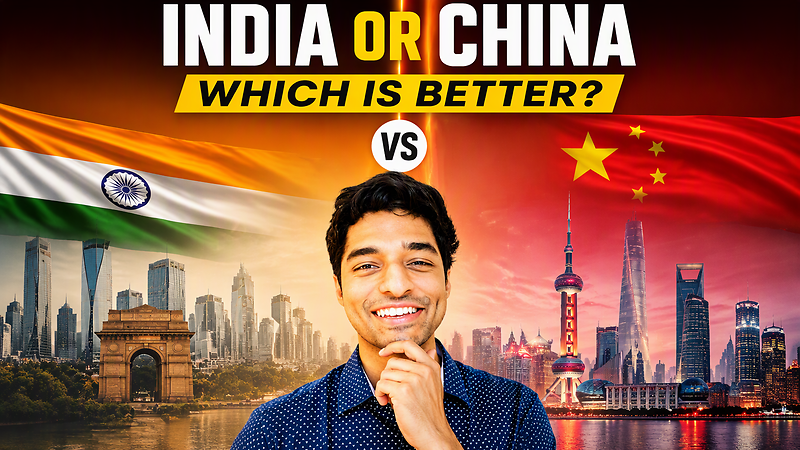
The debate surrounding how China surged ahead of India economically and whether India can catch up is increasingly contentious among various content creators. Sharan Hegde, a popular Youtuber, emphasizes that while the United States remains the strongest economy, China is rapidly advancing, especially in technology. He argues, "Economically speaking, the US is the most powerful... China is coming up fast... but India is still relevant due to its large population and emerging middle class."
Contrastingly, Neha Nagar points to the structural differences in the economic reforms of both nations. She highlights that China initiated reforms in 1980, focusing on manufacturing, while India only began significant reforms in 1991, prioritizing services. "China has advanced in semiconductors, AI, and manufacturing, while we have lagged behind in hardware, despite excelling in IT services," she states. Nagar believes that India’s recent deep-tech initiatives could transform its technological landscape in the coming decades, although it may take time.
Adding to this discussion, Shubhankar Mishra presents a more optimistic view regarding India's potential. He asserts that while China maintained a rapid growth rate for three decades, it has now slowed to about 4-5%, whereas India is nearing a 7% growth rate. He argues, "India lifted 410 million people from poverty within 15 years... this all happened in a democracy, which inherently takes longer but is ultimately more sustainable." Mishra’s perspective stresses that India’s youthful population could be a significant advantage as China grapples with an aging demographic due to its one-child policy.
Moeed Pirzada, another Youtuber, contributes a unique angle by discussing the perception of India within China. He notes, "There is admiration for India... a fear that India may ultimately prevail." This sentiment suggests that the rivalry is complex, involving both competition and respect.
Vaibhav Sisinty highlights the educational reforms in both countries, noting that China has dramatically reshaped its university system to focus on AI and technology, eliminating thousands of degrees in the process. He contrasts this with India’s approach, where AI education will become mandatory in schools starting from 2026. "India is solving a readiness problem, preparing a generation for an economy that doesn’t fully exist yet," he argues, suggesting that while execution may take time, the ambition is substantial.
In contrast, Shubhankar Mishra also points out that India lagged behind China in per-capita income in 1980, a gap that has now widened significantly. He attributes this to China’s earlier market openness and investment influx, which allowed it to build a robust manufacturing base. Mishra asserts, "China has benefited from more than a decade of economic advantages over India, which opened its markets much later."
Lastly, the discussion takes a geopolitical turn with Khanversation, who emphasizes China’s leverage over the United States through its control of critical minerals. He suggests that this geopolitical dynamic plays a role in the economic competition between China and India, further complicating India's ability to catch up.
Overall, the debate encapsulates a spectrum of opinions, from optimism about India's growth potential to recognition of the structural challenges it faces compared to China. The perspectives reflect a multifaceted rivalry where economic, demographic, and geopolitical factors intertwine, shaping the future trajectories of both nations.