Market Crashes and War Jitters: Perspectives on Korea and India's Financial Future
Oct 31, 2026, 14:22 IST
Summary
As markets face turmoil, Sayali Rai attributes South Korea's crash to leveraged ETFs, while Anant Ladha suggests India's market crises echo past missed opportunities. Shashank Udupa warns of high leverage in India, and Sanjay Kathuria highlights rising oil prices impacting markets. Ca Bhagyashree Thakkar emphasizes the risks from geopolitical tensions, urging government intervention for stability.
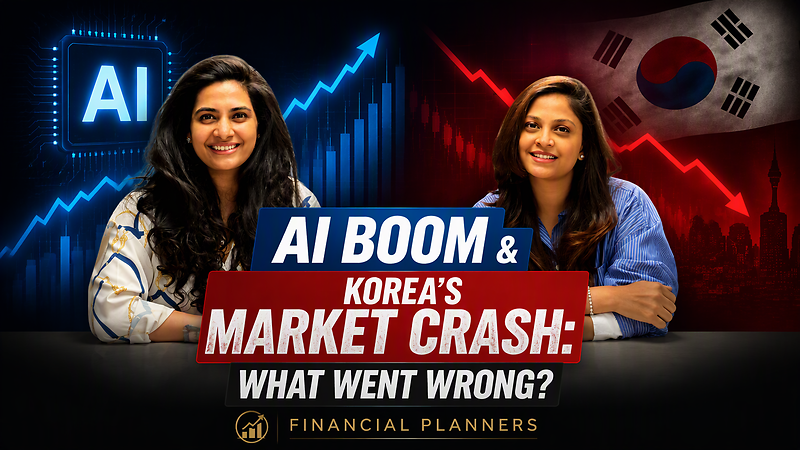
As global markets face turmoil, the interplay of geopolitical tensions and financial missteps is at the forefront of debate among content creators. Sayali Rai, a financial educator, highlights the catastrophic consequences of South Korea's market crash, where the Kospi index soared from 3,000 to over 9,100 during an AI boom, only to plummet by 16% in just two days, wiping out nearly $2 trillion. She attributes this crash to reckless borrowing and the approval of leveraged ETFs, stating, 'The moment prices fall, the broker says, "Add more money to cover your part, or I’ll just sell the shares."' This chain reaction of margin calls led to mass liquidations and a swift market collapse.
In contrast, Anant Ladha, a financial analyst, provides a historical context, arguing that India’s markets have weathered numerous crises—from the Pokhran sanctions in 1997 to the COVID-19 pandemic—suggesting that current fears may echo past missed opportunities. He states, 'Every time people said, "Nothing is going to happen," but we saw significant downturns and recoveries. The current crisis feels threatening, but it may also present an opportunity.' His perspective suggests a cyclical nature to market fears, although he acknowledges the immediate pressures from rising oil prices and foreign institutional investor (FII) outflows.
Meanwhile, Shashank Udupa, a financial commentator, draws parallels between South Korea's situation and India's emerging market, warning that Indian investors are similarly leveraging loans at high rates despite stagnant market returns. He notes, 'India’s MTF book grew from ₹7,000 crore in 2020 to ₹1.27 lakh crore, with traders taking on four-times leverage in a stagnant market.' This alarming trend raises concerns about the potential for a similar crash in India, echoing the devastating experiences of South Korean investors.
Adding to the discourse, Sanjay Kathuria, a market analyst, emphasizes the impact of rising crude oil prices, which have reached $100 per barrel due to geopolitical tensions, particularly the ongoing conflict between the US and Iran. He argues that this situation exacerbates market instability, stating, 'India imports 85% of its crude oil, increasing rupee and inflation risks.' The interconnectedness of oil prices and market performance cannot be overlooked, as these factors weigh heavily on investor sentiment.
Ca Bhagyashree Thakkar, a financial expert, concurs with Kathuria, pointing out that the combination of rising oil prices, geopolitical tensions, and increasing bond yields creates a precarious situation for investors. She notes, 'The US 10-year government bond yields are nearing 5%, prompting investors to reconsider their positions in emerging markets like India.' This sentiment resonates with Udupa's call for government intervention to stabilize the market, suggesting that without proactive measures, the current downturn could signal a larger correction.
As the debate unfolds, voices like Anant Ladha’s remind us of the cyclical nature of market crises, while creators like Sayali Rai and Shashank Udupa highlight the immediate risks of over-leveraging and external pressures. The need for vigilance and strategic decision-making in the face of these challenges is echoed throughout this discourse, leaving investors to navigate a complex landscape fraught with uncertainty.