Should Retail Traders Be Excluded Given High F&O Loss Rates?
Sep 24, 2026, 06:30 IST
Summary
The debate over whether retail traders should be excluded from futures and options trading is intensifying. CA Rachana Ranade reports a decline in total losses but an increase in average losses per trader. Pranjal Kamra argues that only 12% earn above zero, while Ankur Warikoo shares a cautionary tale of a young trader's financial ruin. Together, they highlight the need for greater education and caution.
The debate surrounding the significant losses incurred by retail traders in futures and options (F&O) trading has intensified, especially in light of recent statistics indicating that a staggering 91% of these traders lose money. Content creators are weighing in on whether retail participation should be restricted in this volatile trading environment.
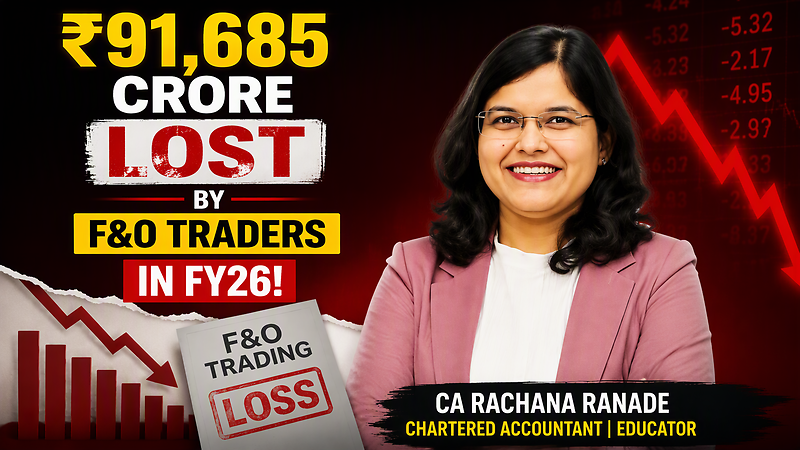
CA Rachana Ranade, a financial educator, highlights the data showing that individual F&O traders lost ₹91,685 crore in FY26, a decrease from ₹1.12 lakh crore in FY25. She notes that the number of individual traders also declined from 98.1 lakh to 78.6 lakh during the same period. However, she points out a troubling trend: while total losses decreased, the average loss per trader actually increased from ₹1.14 lakh to ₹1.17 lakh. Ranade attributes this phenomenon to regulatory measures introduced in November 2024, which included increasing contract sizes and tightening position limits. "What impact did these measures have?" she asks, inviting viewers to consider the implications of these changes.
On the other hand, popular YouTuber Pranjal Kamra offers a more pessimistic view of the F&O trading landscape. He argues that while 12% of traders might be earning above zero, this is not a true measure of success. "You need to exceed long-term market performance to justify the costs and risks associated with trading," he states. Kamra asserts that fewer than 1% of F&O traders achieve returns over 20%, suggesting that the majority are better off with long-term investing strategies. His perspective raises questions about the viability of retail trading when the risks and potential losses appear so substantial.
Adding a personal narrative to the discussion, Ankur Warikoo, a popular influencer, shares a cautionary tale of a 21-year-old who began forex trading after being influenced by social media. He recounts how the young trader lost his savings and salary, ultimately accruing nine personal loans to cover mounting debts. Warikoo's story illustrates the potential dangers of retail trading, particularly for inexperienced individuals who may be drawn in by the allure of quick profits. He underscores the importance of financial education and responsible investing.
While CA Rachana Ranade acknowledges the decline in total losses among retail traders, she also highlights the concerning increase in average losses for those who remain in the market. Pranjal Kamra echoes this sentiment by arguing that even the 12% of traders who are technically profitable are not truly succeeding unless their returns surpass long-term benchmarks. Warikoo’s narrative adds a human element, emphasizing the real-life consequences of trading losses and the need for caution among young investors.
In conclusion, the debate over whether retail traders should be kept out of F&O trading hinges on the balance between potential rewards and the evident risks. With a significant majority losing money, creators like Ranade, Kamra, and Warikoo are calling for greater scrutiny and education around retail trading, highlighting the need for informed decision-making in a high-stakes environment.