The Stagnation of India's Middle Class: A Multifaceted Debate
Oct 27, 2026, 18:35 IST
Summary
The debate on why India's middle class feels stuck includes perspectives from Neha Nagar, who critiques the narrow income definition, Prateek Srivastav, who highlights housing affordability issues, Vaibhav Sisinty, who challenges the effectiveness of hard work alone, and Ishkaran Singh Bhandari, who warns of economic shocks affecting job security. Together, they illustrate the complex challenges facing this demographic.
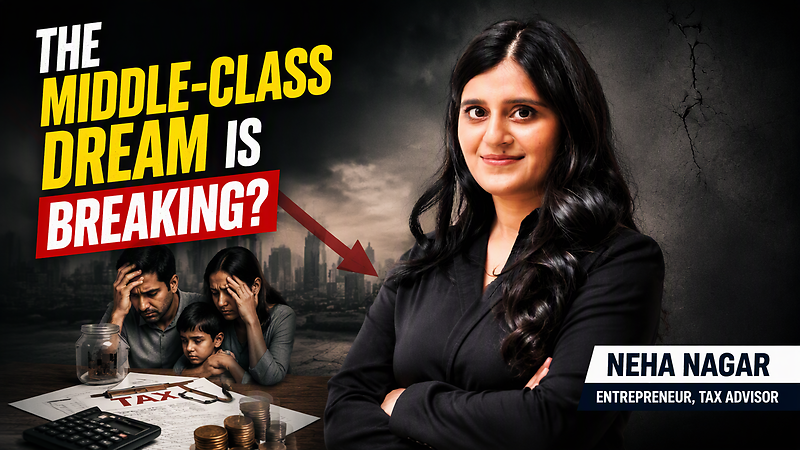
The question of why India's middle class feels stuck has sparked diverse perspectives among content creators, revealing a complex interplay of economic realities and societal expectations. Neha Nagar, a prominent commentator, argues that the definition of middle class in India is too narrow. She asserts that those earning between ₹5 lakh and ₹30 lakh annually, often considered middle class, only control 25–30% of the nation's income. Nagar claims, 'Capturing half of India’s income requires extending middle-class income to ₹1 crore,' suggesting that the current classification fails to reflect economic disparities.
On the other hand, Prateek Srivastav, a popular YouTuber, highlights the pressing issue of housing affordability in Delhi NCR. He states, 'Delhi NCR’s rising real-estate market offers little housing within ₹1 crore,' noting that individuals earning ₹3 lakh monthly find it increasingly difficult to secure homes. This perspective complements Nagar's argument by illustrating how economic stagnation manifests in practical terms—access to housing remains a significant barrier for the middle class.
Adding another layer to the discussion, Vaibhav Sisinty challenges the notion that hard work guarantees financial success. He contends, 'Hard work alone has never made workers wealthy despite twelve-hour workdays.' Sisinty emphasizes the importance of solving valuable problems rather than merely putting in hours, arguing that many workers remain trapped in low-paying jobs despite their efforts. This viewpoint resonates with Nagar's critique of the limited economic power attributed to the current middle-class income range.
Meanwhile, Ishkaran Singh Bhandari raises concerns about impending economic shocks, particularly regarding job security. He warns that mass layoffs, such as Microsoft's recent decision to let go of 61,000 employees, threaten the financial stability of middle-class families managing mortgages and education expenses. Bhandari states, 'Economic conservatism is essential; avoid unnecessary spending,' highlighting the precariousness of the current job market, which further complicates the middle-class experience.
While Nagar and Bhandari focus on income definitions and job security, Srivastav provides a concrete example of how these issues affect daily life through housing challenges. Sisinty, in contrast, pushes back against traditional narratives of hard work, suggesting that merely working long hours is insufficient for upward mobility. Together, these perspectives create a nuanced understanding of why India's middle class feels trapped, showcasing a blend of economic analysis and real-world implications that underscore the urgency of addressing these challenges.
In conclusion, the debate surrounding India's middle class reveals a tapestry of interconnected issues, from income distribution and housing affordability to job security and the value of hard work. Each creator contributes unique insights that reflect the broader struggle of a demographic often caught between aspiration and reality.