Weak Rupee: Balancing Export Competitiveness and Rising Import Costs
Oct 12, 2026, 17:08 IST
Summary
The debate on India's weak rupee reveals contrasting views on its effects. Major Gaurav Arya argues that the Special Rupee Vostro Accounts enhance export competitiveness. In contrast, Sayali Rai warns of rising import costs and investment losses due to currency depreciation. Dr. Qamar Cheema highlights increased defence spending as a response to these economic pressures.
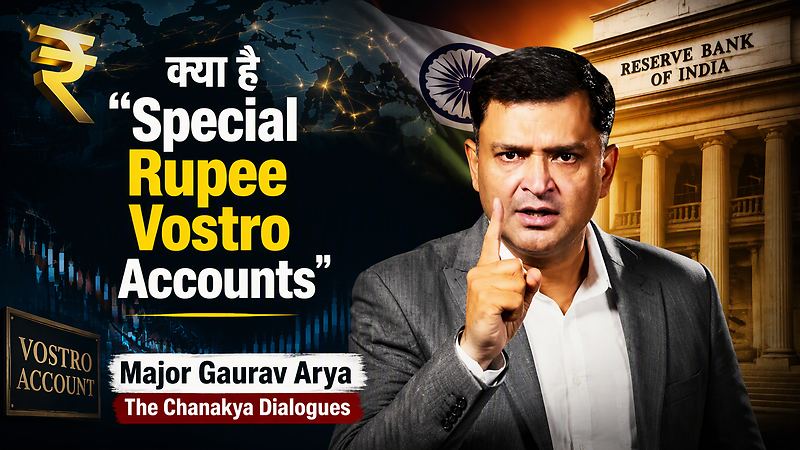
The debate surrounding India's weak rupee brings forth contrasting perspectives on its implications for export competitiveness and import costs. Major Gaurav Arya, a commentator on The Chanakya Dialogues, argues that the introduction of Special Rupee Vostro Accounts in 2022 has bolstered India’s ability to engage in international trade without relying on the dollar. He states, 'You can trade with Russia using Indian rupees, thus bypassing sanctions,' highlighting how this system can enhance export sustainability while reducing dependency on foreign currencies.
In contrast, Sayali Rai, a financial analyst on Finn Cocktail, paints a stark picture of the falling rupee's impact on investments. She notes that foreign investors holding Indian stocks have lost around 6% of their investments this year solely due to currency depreciation, stating, 'This isn’t just an investment problem; everything just got more expensive.' Rai identifies three key reasons for the rupee's decline: rising oil prices, foreign outflows, and a strong dollar, suggesting a complex interplay between global economic factors and domestic currency strength.
While Arya focuses on the export advantages of a weaker rupee, Rai emphasizes the broader economic consequences. This divergence raises questions about the overall economic signal sent by a depreciating currency. For instance, while a weaker rupee may enhance export competitiveness, it simultaneously escalates import costs, particularly for essential commodities like oil, which India heavily imports.
Dr. Qamar Cheema, a commentator on Global Politics, adds another layer by discussing India’s increased defence spending, which he links to the rupee's performance. He highlights that India’s Defence Acquisition Council approved procurements worth ₹1.1 trillion, underscoring a 24% increase in the defence budget. This suggests that a weak rupee might compel the government to bolster domestic industries, potentially offsetting some negative impacts of currency depreciation.
The perspectives of Arya and Rai intersect on the notion that a weak rupee has both advantages and disadvantages. Arya’s optimism regarding export opportunities contrasts sharply with Rai’s caution about the rising costs for imports and the potential long-term economic repercussions. This debate reflects a broader tension in economic policy: how to leverage a weaker currency for competitive advantage while mitigating its adverse effects on inflation and living costs.
Ultimately, as the rupee fluctuates, the challenge remains for policymakers to strike a balance that fosters export growth without exacerbating import-related inflation. The contrasting views of these commentators reveal the complexities of currency dynamics and their far-reaching implications for the Indian economy.