Do India's Clean-Air Programmes Deliver Results Amid Rising Pollution?
Oct 28, 2026, 20:13 IST
Summary
The debate over India's clean-air programmes reveals a troubling reality: significant funding has not led to improved air quality. Faye D'Souza highlights a study showing worsening pollution in Delhi despite GRAP measures, while also noting that 117 of 130 cities exceed national PM10 limits. Both perspectives call for a focus on reducing emissions at the source rather than relying solely on emergency measures.
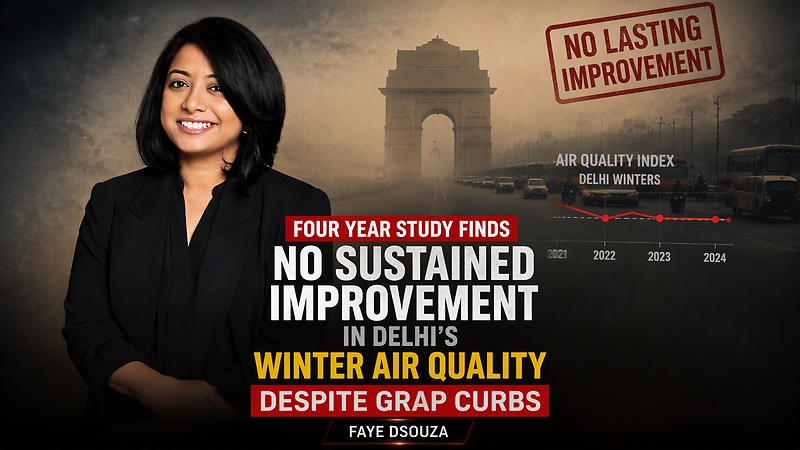
The efficacy of India's clean-air programmes is under scrutiny as significant funding fails to yield the expected results. Faye D'Souza, a popular YouTuber, highlights alarming findings from a four-year study indicating that despite Delhi spending nearly four out of every five winter days under strict pollution control measures, there has been no consistent improvement in the city's air quality. According to her, "Delhi's average winter AQI rose from 280 in 2022-23 to 295 in 2025-26," raising concerns about the effectiveness of the Graded Response Action Plan (GRAP). The study, conducted by the Centre for Research on Energy and Clean Air (CREA), examined air quality during 12 episodes of tightened restrictions, finding that air quality worsened in 10 of these instances. D'Souza questions whether GRAP is ineffective, suggesting that it may help limit pollution peaks but cannot eliminate the sources of emissions, which continue to plague the city throughout the year.
In a related perspective, D'Souza discusses the broader implications of India's clean-air initiatives, noting that over ₹12,000 crore has been spent on clean air efforts, yet only 21 of 130 cities achieved the revised target of reducing PM10 pollution by more than 40%. She points out that by 2025-26, 117 of these cities were still exceeding the annual PM10 limit of 60 micrograms per cubic metre. D'Souza underscores the troubling situation in Maharashtra, where cities like Navi Mumbai and Nashik saw significant increases in PM10 levels despite funding under the National Clean Air Programme (NCAP). She argues that, "the question is no longer just how much money is being spent but whether it is addressing the sources of pollution and delivering measurable results."
While both perspectives from D'Souza present a grim picture of air quality in India, they also highlight a crucial nuance: the limitations of emergency measures like GRAP. D'Souza advocates for a shift in focus towards reducing emissions at the source rather than relying solely on temporary controls. The overlapping concerns about pollution control measures and their enforcement resonate throughout her arguments, suggesting that a comprehensive approach is necessary to tackle the systemic issues contributing to air pollution.
This debate raises important questions about accountability and the future direction of India's clean-air initiatives. As the nation grapples with worsening air quality, the voices calling for more effective strategies grow louder, urging a reevaluation of current policies and their implementation to ensure cleaner air for all.