Is India's Infrastructure on the Brink of Collapse?
Sep 4, 2026, 14:40 IST
Summary
Debate intensifies over India's failing infrastructure as voices like Think School Ganeshprasad and Rajdeep Sardesai highlight project delays and tragic accidents. Faye D'Souza points to specific failures, while Barkha Dutt raises concerns about bridge safety during monsoons. Sandeep Deo offers a more optimistic view, suggesting improvements are on the horizon. The discourse reflects deeper issues of governance and accountability.
The ongoing debate surrounding India's infrastructure has intensified as roads cave in and bridges wash away, prompting urgent questions about the state of public works in the country. Various voices in the media are weighing in on the issue, highlighting systemic failures and raising alarm over safety concerns.
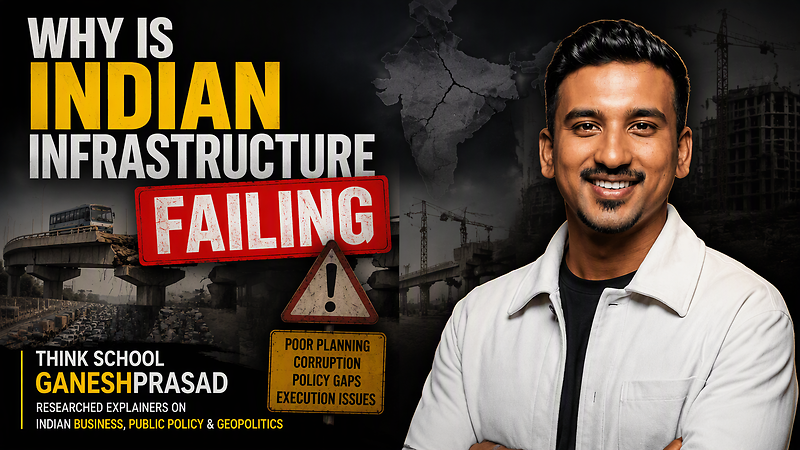
Think School Ganeshprasad, a popular YouTuber, points to a significant failure in infrastructure projects, citing that 'Nitin Gadkari reported 629 of 1,191 infrastructure projects delayed in July 2026.' He argues that factors such as land acquisition, court cases, and local conditions are contributing to these delays, creating a cycle of excuses from the government. Ganeshprasad expresses frustration over the government's response, which often promises repairs while visible failures persist.
In a similar vein, Rajdeep Sardesai, a prominent journalist, addresses the human cost of infrastructure failures. He recounts the tragic story of eleven-year-old Vihan Shivasav, who died when a tree fell on his school bus during the monsoon. Sardesai laments, 'Every monsoon, we witness the same horrific scenes... It's a governance problem in India.' He criticizes local officials for shifting blame to the weather or contractors instead of addressing the underlying issues of corruption and mismanagement. His strong assertion that 'political, contractor, and official collusion enables wasteful spending without accountability' underscores a sentiment of deep mistrust in the system.
Faye D'Souza, another influential voice, highlights a specific incident where a ₹40 crore Smart City road caved in near Gorakund Chowk, Indore, after a high-pressure water burst. This incident adds to the growing list of infrastructure failures that have raised questions about the efficacy of government spending on public works.
Meanwhile, Barkha Dutt, a respected journalist, raises concerns about bridge safety in the context of the monsoon season. She references the collapse of a bridge in Uttarakhand, which serves as a stark reminder of the vulnerabilities in India's infrastructure during adverse weather conditions. Dutt's commentary reflects a broader anxiety about the adequacy of existing structures to withstand natural challenges.
In contrast, Sandeep Deo from India Speak Daily takes a more optimistic stance, asserting that 'within two years, India’s road infrastructure will match America’s.' However, he acknowledges the immediate challenges, highlighting that a ₹16 crore road sank within just 17 days, calling into question the quality of construction and oversight.
Deo also points to the flooding of Delhi Airport, framing it within a narrative of administrative backlogs accumulated over 27 years. His position seems to straddle a line between hope for future improvements and frustration with the current state of affairs.
The debate is not just about infrastructure; it is a reflection of governance, accountability, and public safety. As voices like Sardesai and Ganeshprasad call for systemic change and accountability, others like Deo offer a glimmer of hope for improvement. The contrasting views on whether India's infrastructure is failing or simply in need of reform create a complex picture of a nation grappling with its developmental challenges.