Ritual Repayment or Ecological Duty? The Debt to Nature Debate
Oct 22, 2026, 10:00 IST
Summary
The debate on humanity's debt to nature explores whether it is best understood through ritual repayment or ecological responsibility. Rajiv Malhotra argues for both spiritual practices and recognition of nature's rights, suggesting a complex relationship between humans and the environment that requires a holistic approach to ecological duty.
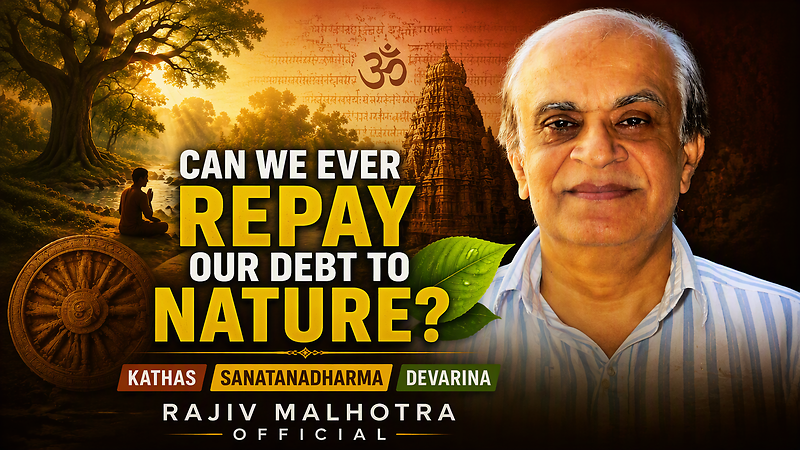
As the conversation around humanity's relationship with nature evolves, content creators are exploring the concept of 'debt to nature' through various lenses. Central to this debate is whether this debt is best understood through ritual repayment or as an ecological responsibility.
Rajiv Malhotra, a prominent figure in the realm of Sanatana Dharma, argues from a spiritual perspective. In his video 'Can We Ever Repay Our Debt to Nature?', he posits that 'human existence carries a sacred debt to the air and nature.' He advocates for the practice of yajna or homa, traditional rituals designed to purify the elements, as a means of repaying this debt. Malhotra emphasizes that these rituals are not mere formalities; they are essential acts of gratitude and respect towards the environment that sustains us.
In another video titled 'Deva Rina: What Do We Owe Nature?', Malhotra expands on this idea, introducing the concept of Deva Rina. He explains that this debt is owed not just to the gods, but crucially to nature itself, which he describes as comprising the five great elements: air, space, water, fire, and earth. He asserts that 'breathing air and drinking water create obligations toward conscious divine entities.' This perspective highlights a deeper connection between humanity and nature, suggesting that every breath we take is an acknowledgment of our debt.
However, Malhotra's views raise questions about the nature of this debt. In his video 'Does Nature Have Rights? The Dharmic Perspective', he argues that 'nature has intrinsic value, rights, and responsibilities.' He insists that, according to Dharmic thought, nature is not inert matter but a living entity with which humans are interconnected. This view challenges the traditional notion of humans as the masters of nature, instead positioning us as integral parts of a larger ecological web.
The tension in Malhotra's arguments reveals a nuanced debate within the community. While he consistently presents nature as deserving of reverence and repayment, the methods of acknowledgment differ. The ritualistic approach he advocates can be seen as a form of spiritual responsibility, whereas his emphasis on nature's rights suggests a broader ecological responsibility that extends beyond rituals.
Ultimately, the discussion surrounding the debt to nature is not merely about how we repay it but also about how we perceive our relationship with the environment. As Malhotra illustrates, this debt encompasses both spiritual rituals and a recognition of nature's rights, calling for a holistic approach to ecological responsibility. The challenge lies in integrating these perspectives to foster a deeper respect for the natural world that sustains us all.