Yamuna Cleanup: Are Authorities Concealing Pollution or Making Progress?
Nov 24, 2026, 19:00 IST
Summary
The debate over the Yamuna cleanup reveals contrasting perspectives. Barkha Dutt argues that visible improvements mask ongoing pollution, while Saurabh Shukla highlights the Supreme Court's findings that pollution has increased despite government claims. Both creators call for accountability, questioning the effectiveness of cleanup measures and the transparency of official narratives.
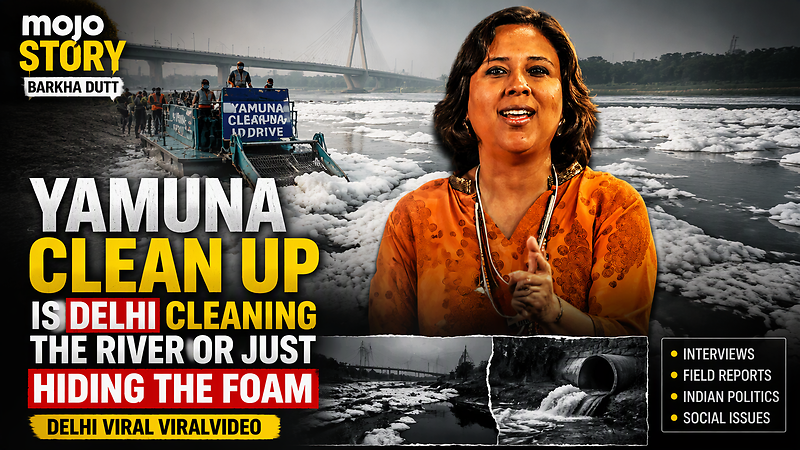
The debate surrounding the cleanup of the Yamuna River has intensified, with contrasting views emerging from various content creators. On one side, Barkha Dutt from Mojo Story raises critical concerns about the effectiveness of the cleanup efforts. She reports that while the visible foam in the river has decreased due to measures like barrage closures and the application of defoamers, these actions merely mask the underlying pollution. Dutt emphasizes that these chemicals do not eliminate sewage or chemical contaminants, stating, 'Defoamer hides foam temporarily but does not remove sewage or chemical pollution.' Moreover, she highlights alarming air quality levels in Delhi, which reportedly reached 350, far above the safe threshold of 50, questioning the overall effectiveness of the cleanup efforts.
Conversely, Saurabh Shukla from The Red Mike critiques the government's claims of progress. He points to a recent Supreme Court statement indicating that despite significant financial investment, pollution levels in the Yamuna have actually increased. Shukla argues that the government’s assertions, particularly those from Minister Pravesh Verma claiming a 60% reduction in pollution, are misleading. He urges accountability, saying, 'Pravesh Verma must explain dead fish, foam, and undisclosed water testing.' Shukla also points to the inadequacy of sewage treatment plants, which he claims are not operating according to required standards, thus exacerbating the pollution problem.
Both creators express skepticism about the government's narrative regarding the Yamuna's cleanliness. Dutt's report suggests that the cleanup efforts may be more about optics than genuine progress, while Shukla's commentary reinforces the idea that official claims are disconnected from reality. Dutt notes the presence of foam even during significant cultural events, questioning whether the government is simply 'hiding the foam' rather than addressing the pollution directly. Shukla echoes this sentiment, stating that the visible pollution—like foam and dead fish—contradicts the government's proclamations of success.
The discourse reveals a deep mistrust of government claims, with both Dutt and Shukla calling for greater transparency and accountability. They agree that pollution persists and that the situation demands urgent attention, but they diverge on the specifics of the government's actions. Dutt focuses on the immediate environmental indicators, while Shukla emphasizes legal and procedural failures within the government’s infrastructure for pollution control.
As the debate continues, the core question remains: Are the cleanup efforts genuinely reducing pollution, or are they merely concealing the ongoing environmental crisis? The perspectives of Dutt and Shukla underscore a critical need for a more honest assessment of the Yamuna's condition and the effectiveness of current policies.