Ayurveda vs Allopathy: A Clash of Healing Philosophies
Nov 3, 2026, 07:34 IST
Summary
The debate between Ayurveda and allopathy is intensifying, with Shubhankar Mishra advocating for an integrated approach that values both systems. He challenges the perception of Ayurveda as slow and highlights its holistic benefits. Dr. Santhosh Jacob emphasizes balanced diets and exercise, while Dr. Mickey Mehta supports alternative treatments without empirical evidence. The discourse suggests a growing interest in combining both practices for optimal health.
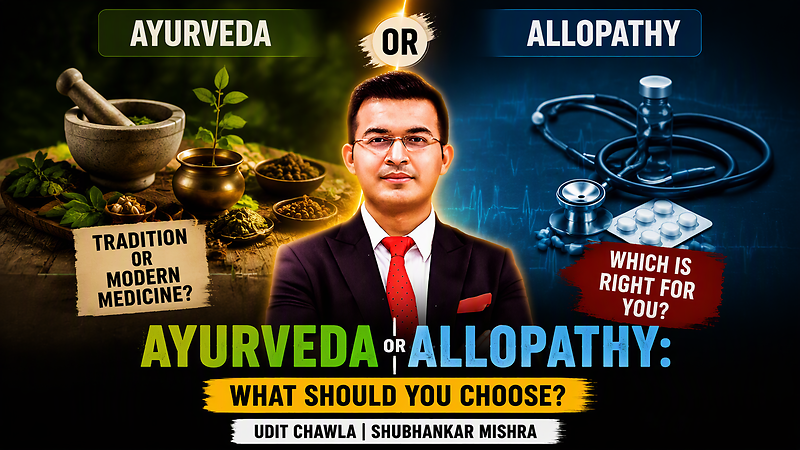
The debate over whether to trust Ayurveda or allopathy is heating up, with various voices weighing in on the strengths and weaknesses of each approach. Shubhankar Mishra, a popular YouTuber, advocates for an integrated healthcare system, arguing that 'Ayurveda and allopathy each have distinct roles in healthcare.' He believes that the future of medicine lies in combining modern treatments with traditional practices. 'You cannot say that one is better than the other; both have their importance,' he insists.
Conversely, Dr. Santhosh Jacob emphasizes the importance of a balanced diet for health, but his focus is on the limitations of traditional foods like urad dal porridge. He argues that while such foods have benefits, they cannot ensure comprehensive health outcomes alone. 'Women’s bone and muscle health requires adequate protein and weight-bearing exercise,' he states, indicating that diet alone, whether Ayurvedic or otherwise, is insufficient.
Mishra continues to explore the perception that Ayurveda is a slow treatment option. He counters this notion by suggesting that 'Ayurveda may resolve early arthritis within six months to three years,' whereas allopathic treatments can lead to lifelong medication dependency. He highlights that 'long-term medication dependence reflects a major failure of the medical system,' suggesting that patients are often left without viable alternatives.
In another video, Mishra points out that while Ayurvedic research is often seen as outdated, it remains relevant due to its holistic approach. He states, 'Ayurveda considers humans as mind-body beings, not merely calories and vitamins.' This contrasts with the allopathic focus on symptom management, which he believes can lead to a neglect of underlying issues.
Mishra also addresses the evolving nature of Ayurveda, claiming that it is adapting to modern needs. He notes that practitioners are increasingly using laboratory tests to enhance Ayurvedic diagnoses, a point that adds nuance to the debate. 'Your diagnosis and treatment should always be informed by investigation,' he argues, suggesting that a blend of traditional and modern practices can lead to better patient outcomes.
Dr. Mickey Mehta, another prominent figure in this discussion, supports the idea that alternative treatments can be effective even without empirical evidence. He cites a personal experience where acupuncture alleviated his wife's severe back pain, asserting that 'healing methods can work without established scientific evidence.' This raises questions about the necessity of scientific validation in medicine, a point that some may find contentious.
Finally, Mishra asserts that Ayurveda can provide effective treatments for autoimmune diseases at a lower cost than allopathy, claiming that 'Ayurvedic treatment reportedly reverses or cures some arthritis, asthma, and psoriasis cases.' He emphasizes that Ayurvedic medicines have no side effects, making them a safer option for many patients.
As this debate unfolds, it becomes clear that while both Ayurveda and allopathy have their advocates, the conversation is evolving towards an integrative approach that values the strengths of each system. The question remains: which path should patients trust for their healing needs?