Jihad: A State Duty or Individual Violence?
Nov 26, 2026, 16:41 IST
Summary
Shubhankar Mishra argues that jihad is a state duty, only to be declared by leaders, not individuals. He criticizes the misuse of the term during the pandemic and asserts that true Islamic commitment is based on the Quran and Hadith, not terrorism. His perspective highlights the need for unity and proper leadership in the Muslim community to combat misinterpretations of jihad.
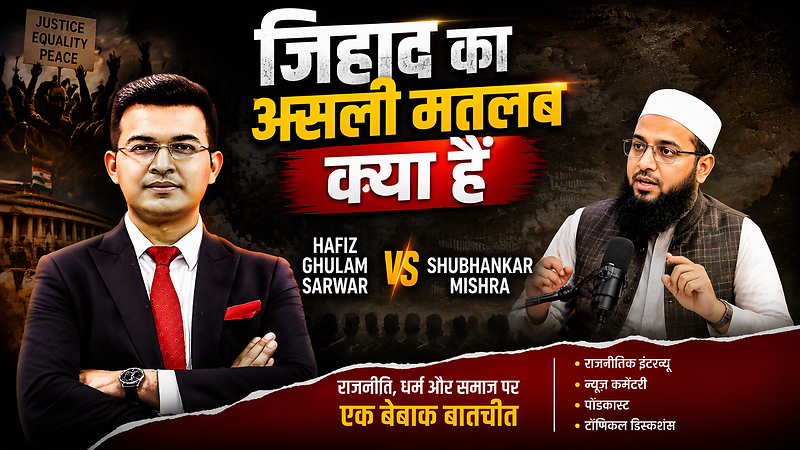
The concept of jihad has ignited intense debate among content creators, with contrasting views on whether it is a religious duty or a guise for unauthorized violence. Shubhankar Mishra, a popular YouTuber, argues in his video about the true meaning of jihad that it should only be declared by a state leader when conflict becomes unavoidable. He emphasizes, 'Jihad is defined here as open warfare when conflict becomes unavoidable,' reinforcing that 'only a state head can issue instructions for jihad.' Mishra critiques the misuse of the term, noting how it has been manipulated during the pandemic with terms like 'Corona Jihad' and 'Spit Jihad.' He urges both Muslim leadership and the general populace to break free from the cycle of blame surrounding these misinterpretations.
In a different video, Mishra further explores the notion of what constitutes a radical Muslim, asserting that true commitment to Islam stems from living according to the Quran and Hadith. He states, 'Following the Quran and Hadith defines religious commitment, not involvement in terrorism.' He vehemently opposes the idea that individuals can unilaterally declare jihad, stressing that such authority lies with a king, emir, or caliph, and criticizes groups like Al-Qaeda for conducting unauthorized jihad without legitimate rules or legal authority. 'Al-Qaeda conducts unauthorized jihad without legitimate rules or legal authority,' he claims, emphasizing the need for unity and proper leadership within the Muslim community.
The contrast in perspectives is stark. While Mishra insists on the necessity of state authorization for jihad, he also highlights the damaging effects of terrorism on the perception of Islam. His call for a collective Muslim response to mislabeling underscores the need for clarity and leadership in addressing these issues. In both videos, he consistently argues against the individualistic approach to jihad, positioning it firmly within the realm of state duty.
This debate reflects a broader tension in how jihad is understood within the Muslim community and beyond. On one hand, there is a push to reclaim the term from extremist interpretations, as Mishra articulates. On the other, there is a recognition of the ongoing challenges posed by those who misappropriate the concept for violence. The discourse surrounding jihad is not just about definitions; it encompasses issues of authority, representation, and the struggle for a coherent narrative in the face of misrepresentation and fear.
Ultimately, the question remains: Is jihad a sacred duty reserved for state leaders, or has it been hijacked by individuals seeking to justify violence? Shubhankar Mishra's arguments contribute significantly to this critical discussion, emphasizing the need for authoritative guidance and a unified response to terrorism's impact on Islam's image.