One Divine Reality or Many Forms of God? The Debate Unfolds
Oct 28, 2026, 17:00 IST
Summary
The debate over the nature of divinity features contrasting perspectives. Rajiv Malhotra argues for a nuanced understanding of Brahman, distinguishing between its formless and manifested aspects. In contrast, Shubhankar Mishra advocates for the unity of all religious traditions, critiquing Hinduism's divisions. This discourse reveals a rich exploration of spirituality, balancing philosophical abstraction with practical implications.
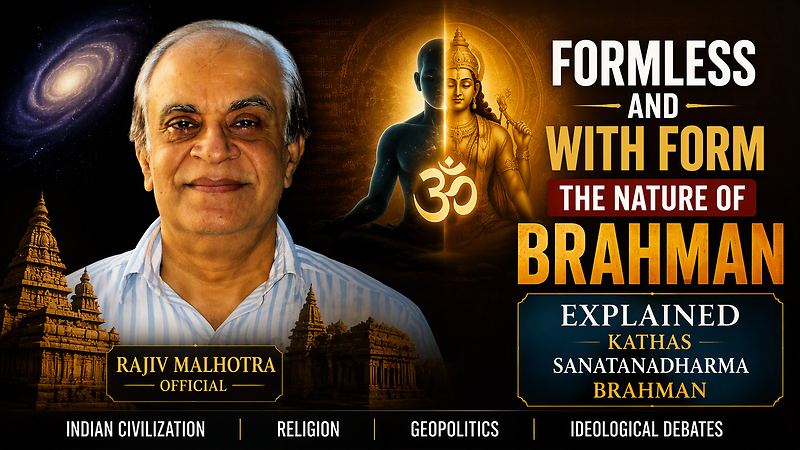
In the ongoing debate about the nature of divinity, perspectives diverge sharply on whether there is one ultimate reality or multiple forms of God. Rajiv Malhotra, a prominent commentator on spirituality, argues for a nuanced understanding within Hindu philosophy. He explains that Nirguna Brahman represents the formless, infinite aspect of the divine, transcending all attributes, while Saguna Brahman embodies God in accessible forms, allowing devotees to engage through worship. Malhotra emphasizes that worship is directed towards Ishvara, the manifested form of Brahman, which can be experienced through devotion.
On the other hand, Shubhankar Mishra, a popular YouTuber, presents a more unified view of divinity. He posits that all religious traditions ultimately worship the same underlying divine power, likening the different perceptions of God to various vessels drawing water from a single well. According to him, individuals may see this power as Krishna, Rama, or Mahadev, depending on personal preference, yet they all connect to the same essence. Mishra draws on the metaphor of water, stating, "the water is the same, but the vessels differ."
However, Mishra also critiques Hinduism for its lack of a central focus of worship, noting the presence of divisions among devotees. He points out historical conflicts, such as the disagreements surrounding Chhath Puja, where figures like Bal Thackeray and Lalu Prasad Yadav took opposing stances. He suggests that these divisions illustrate a broader issue within Hinduism, where superstitions and differing practices complicate the worship of a singular divine entity.
While Malhotra focuses on the philosophical aspects of Brahman, Mishra’s critique highlights the practical implications of these beliefs in contemporary society. This contrast reveals a nuanced layer to the debate, as Malhotra advocates for understanding the divine through both formless and formed manifestations, while Mishra calls for recognition of a singular essence amidst diverse practices.
The discussion continues with varying degrees of agreement and disagreement. While both creators acknowledge the complexity of the divine, Malhotra emphasizes the transcendent nature of Brahman, whereas Mishra urges a collective recognition of the unity in diversity among different religious practices. This tension between philosophical abstraction and practical application illustrates the richness of the discourse surrounding the divine, inviting further exploration into the depths of spiritual understanding.