Penguin Drops Sonia Gandhi's Memoir: A Clash of Publishing Caution and Political Pressure
Aug 29, 2026, 09:59 IST
Summary
The withdrawal of Penguin Random House India from publishing Sonia Gandhi's memoir has sparked a heated debate. Ashok Kumar Pandey argues it was due to suggested edits on sensitive topics, while Deepak Sharma claims political pressure from the Gujarat lobby influenced the decision. Sakshi Joshi and Barkha Dutt highlight concerns about editorial freedom and the implications of suppressing significant narratives.
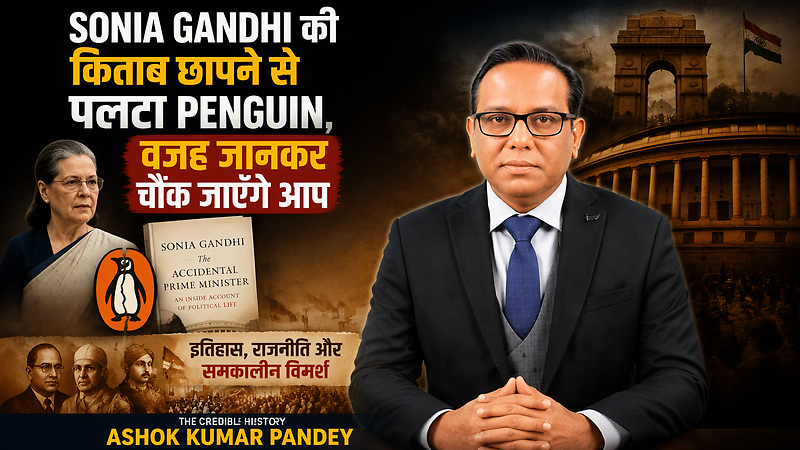
The decision by Penguin Random House India to withdraw from publishing Sonia Gandhi's memoir has ignited a fierce debate among content creators regarding the motivations behind this move. While some argue it reflects editorial caution, others contend it is a result of external political pressure.
Ashok Kumar Pandey, a popular YouTuber, claims that Penguin India initially planned to publish Gandhi's autobiography but reversed its decision due to suggested edits concerning sensitive topics like Narendra Modi, China, and the Rashtriya Swayamsevak Sangh (RSS). In his video, he asserts, "Penguin India withdrew from publishing Sonia Gandhi’s biography in India," highlighting that the publisher requested the removal of certain passages, which Gandhi refused. Pandey challenges Penguin’s integrity, questioning how they could suggest edits if they were not the book's publisher, suggesting that they are "lying" about their involvement.
On the other hand, Deepak Sharma, another YouTuber, supports the idea of political pressure influencing Penguin's decision. He alleges that the "Gujarat lobby" pressured the publisher to prevent the memoir from being released, stating, "Agencies and Gujarat lobby allegedly pressured Penguin India over Sonia Gandhi's autobiography." Sharma believes that in the current political climate, even major publishers like Penguin struggle to stand against such pressure, which he argues is indicative of a larger trend of media surrendering to governmental authority.
Sakshi Joshi, a popular YouTuber, echoes concerns about the implications of Penguin’s decision, arguing that it reflects a broader issue of editorial freedom. She notes that the memoir, which was highly anticipated for release in November, contains references to significant events, including institutional pressures and the 2002 riots. Joshi suggests that the refusal to publish could stem from a desire to suppress uncomfortable truths, questioning, "What are the reasons for such pressure?" She also hints at the potential for other publishers to step in, stating, "Many people believe that Sonia Gandhi's memoir could become a bestseller, even without a major publisher."
Barkha Dutt, a well-known journalist and creator behind Mojo Story, succinctly encapsulates the situation by stating that Penguin's withdrawal is tied to references in Gandhi's memoir concerning Modi and the RSS. Dutt's perspective emphasizes the political dimensions of the publishing decision, suggesting that the fallout is indicative of the contentious relationship between the current government and dissenting voices.
The perspectives of these creators reveal a complex interplay of editorial caution, political pressure, and the quest for narrative control. While Ashok Kumar Pandey and Deepak Sharma focus on the implications of external influences on publishing, Sakshi Joshi and Barkha Dutt bring attention to the potential suppression of important historical narratives. This debate highlights the precarious position publishers find themselves in amid a politically charged environment, raising questions about the future of free expression in literature and journalism.