Rewriting Indian History: Correction or Distortion?
Oct 24, 2026, 22:00 IST
Summary
The debate on rewriting Indian history features diverse perspectives. Ajeet Bharti critiques reservation policies for benefiting specific castes while neglecting others. Khanversation emphasizes colonialism's impact on current issues. Sandeep Deo questions the historical role of the RSS, while Sharan Hegde highlights India's trade legacy. The Sham Sharma Show critiques Gandhi, and Shubhankar Mishra explores the roots of Hindustani Muslims, reflecting a complex discourse on historical narratives.
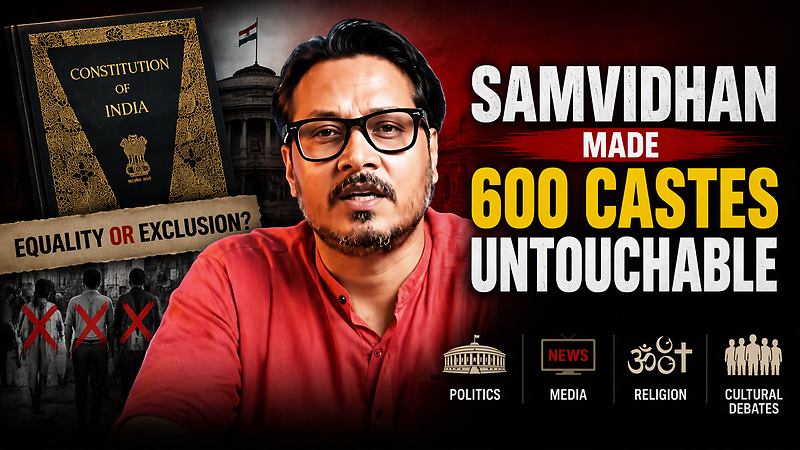
The debate surrounding the rewriting of Indian history has sparked intense discussions among various content creators, each presenting their own interpretations and claims. Ajeet Bharti, a prominent YouTuber, argues in his video "Samvidhan Made 600 Castes Untouchable?" that the Indian Constitution added 600 more castes to the already existing 600 considered untouchable in 1952. He contends that this has led to disproportionate benefits for certain communities, such as Meena and Jatav, while many OBC castes remain underrepresented in government jobs. Bharti calls for a reevaluation of reservation policies, suggesting they perpetuate inequality rather than rectify it.
On the other hand, Khanversation, in "How Colonialism Broke South Asia's Future," attributes many of South Asia's contemporary issues to its colonial past. He emphasizes that British colonialism extracted immense wealth from the region, resulting in long-term economic challenges. He asserts that the historical narrative must acknowledge this context to understand current socio-economic conditions.
In a similar vein, Sandeep Deo from India Speak Daily claims in "खुल गया झूठे इतिहास गढ़ने का खेल!" that certain groups manipulate historical narratives to elevate their status, particularly during significant movements like the 1942 Quit India Movement. He criticizes the RSS and its founder, Golwalkar, for allegedly avoiding participation in the movement while later claiming a historical role. This perspective challenges the authenticity of narratives that paint these groups as central to India's freedom struggle.
Sharan Hegde counters this with a focus on India's historical role in global trade, arguing in "India Dominated Global Trade Before 1991" that India was a trade epicenter long before economic reforms in 1991. He cites historical evidence of extensive trade relations dating back to ancient times, countering claims that India was isolated until recent reforms.
In a controversial take, The Sham Sharma Show questions Mahatma Gandhi's legacy in "Dark Reality of Mahatma Gandhi," suggesting that his support for the Khilafat Movement alienated influential leaders like Ambedkar and ultimately failed to advance Indian independence. He portrays Gandhi's actions as politically motivated rather than genuinely nationalistic.
Conversely, Shubhankar Mishra, in "गांधी जी ने भगत सिंह को नहीं बचाया?", discusses the complexities of Gandhi's relationship with revolutionary figures like Bhagat Singh. He asserts that while Gandhi had opportunities to intervene on behalf of Singh, their ideological differences made collaboration unlikely.
Debates also arise around the Aryan Invasion Theory, which Ajeet Bharti critiques in "कैसे Aryan Invasion Theory का झूठ परोस रही है मोदी सरकार?" He argues that recent genetic research disproves this theory, claiming the current education system perpetuates outdated narratives. He links this to broader concerns about how history is taught in schools under the Modi government.
In a provocative stance, Shubhankar Mishra also explores the conversion of Hindustani Muslims in "हिंदुस्तानी मुसलमान CONVERTED?" He posits that many Muslims in India trace their roots back to indigenous communities, challenging the notion that their ancestry is solely foreign.
The perspectives reveal a complex landscape of historical interpretation in India, with creators arguing over the implications of these narratives on contemporary identity, politics, and social structures. While some advocate for a revisionist approach to highlight underrepresented histories, others warn against distorting historical truths for political gain.