Varna Identity: Birthright or Conduct?
Oct 25, 2026, 07:30 IST
Summary
Shubhankar Mishra argues that Brahmin identity has shifted from conduct-based to birth-based in modern times, while Ajeet Bharti claims that identity is more about societal roles than lineage. This debate highlights contrasting views on varna identity and its implications in contemporary society, questioning the relevance of traditional caste definitions.
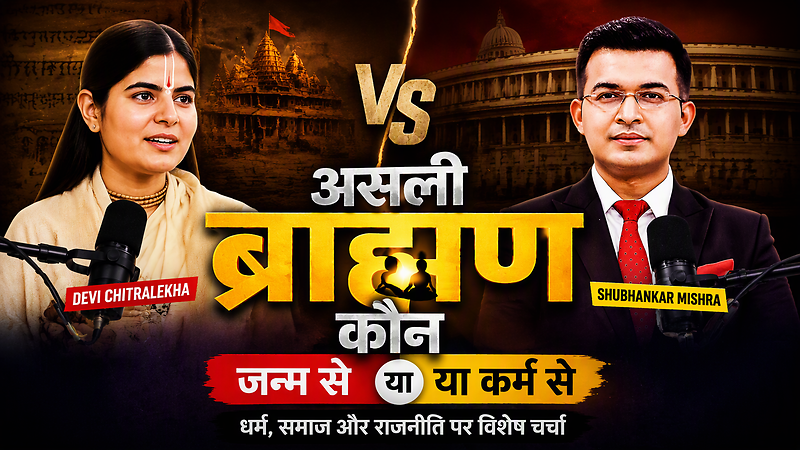
The debate surrounding the nature of Brahmin identity in the varna system has intensified, with distinct perspectives emerging from content creators. Shubhankar Mishra, a popular Youtuber, argues that the definition of who qualifies as a Brahmin has shifted over time. In his video, he states, "Brahmin status was formerly based on conduct, scholarship, and integrity," suggesting that historically, one's actions and intellect determined their varna identity rather than their birth. However, Mishra notes that in the current Kali Yuga, the interpretation has changed to a birth-based identity, asserting, "Earlier varna categories existed but were determined by occupation, not birth."
On the other hand, Ajeet Bharti presents a contrasting view. This influencer delves into the symbolism of the Purusha Sukta, claiming that it represents individuals, society, and the cosmos. He asserts that the term 'Shudra' refers to those in the service sector, rather than being synonymous with lower castes like Chamar or Dalit. Bharti provocatively states, "Each person performs all four varna roles during daily life," indicating that everyone embodies multiple roles throughout their day, which challenges the strict categorization of individuals based solely on their birth.
While Mishra highlights a historical evolution towards a birth-based identity, Bharti's perspective emphasizes a more fluid understanding of identity, suggesting that societal roles are more critical than the lineage from which one originates. This divergence raises important questions about the implications of these beliefs on contemporary society.
The two creators, while discussing the same foundational concepts, arrive at different conclusions about the implications of varna identity. Mishra’s focus on historical context implies a need for re-evaluation of identity constructs in light of modern values, while Bharti's emphasis on role-based conduct promotes a more inclusive understanding of identity that transcends traditional boundaries.
As the discussion unfolds, it becomes clear that the definitions of varna and Brahmin identity are not only about lineage but also about the roles individuals play in society. This ongoing debate reflects broader societal changes and challenges the rigidity of traditional caste definitions, urging a reconsideration of what it means to belong to a particular varna in today's world.