12 Years of BJP: A Journey of Progress or Unfulfilled Promises?
Oct 27, 2026, 11:00 IST
Summary
The debate over the BJP's 12 years in power showcases contrasting views. Critics like Ganeshprasad highlight unfulfilled promises, while supporters like Sanjay Dixit celebrate infrastructure achievements. Yogendra Yadav questions the government's accountability, and Neha Singh Rathore points to the suffering of the poor. The discussion reflects a nation divided on its political journey.
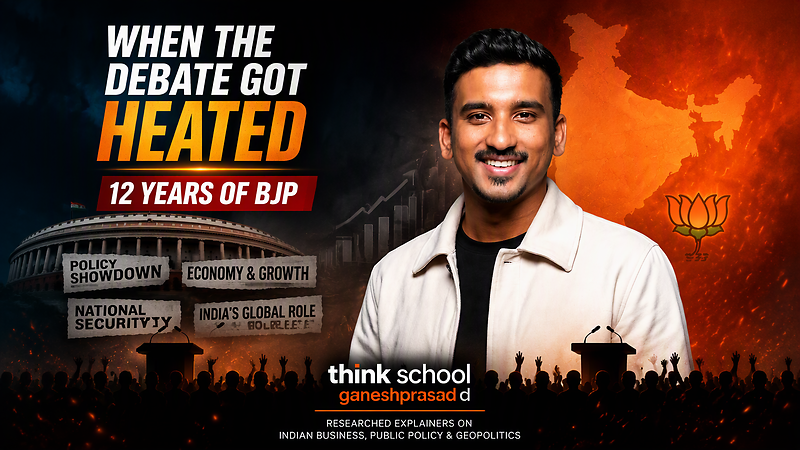
The debate surrounding the Bharatiya Janata Party's (BJP) 12 years in power reveals starkly divided opinions among various commentators. Popular YouTuber Ganeshprasad from Think School presents a critical view, asserting, "Twelve years is enough time for real progress to be evident, not just excuses." He emphasizes the need for accountability and tangible results, particularly in states like Jharkhand and Punjab.
In contrast, Ganeshprasad also notes in another video that while some view the BJP's tenure as marked by significant advancements, including doubled airports and electrified railways, others argue that infrastructure is crumbling and inflation is crushing the poor. He highlights, "Optimists believe India has made revolutionary leaps, but pessimists see marketing masquerading as progress."
This dichotomy is echoed by Sanjay Dixit from The Jaipur Dialogues, who celebrates the completion of India's Dedicated Freight Corridor, a major infrastructure project that he claims enhances logistics efficiency and contributes to economic growth. He states, "This is India's biggest rail revolution, providing a dedicated high-speed track for freight trains."
On the other hand, Harsh Vardhan Tripathi critiques the economic trajectory since 2014, arguing that the previous government under Manmohan Singh hindered progress initiated by Atal Bihari Vajpayee's reforms. He claims, "India was pushed back 40 years, but the work resumed after 2014."
Conversely, Yogendra Yadav raises serious concerns about the government's accountability, questioning the validity of its promises and the lack of legal backing for its agreements. He argues, "The government's statements lack legal status and binding guarantees, casting doubt on their reliability."
Sandeep Deo from India Speak Daily highlights unfulfilled promises, urging the BJP to address rising sugar prices and unemployment before celebrating achievements. He states, "The youth face unemployment while basic services like education and healthcare remain inadequate."
Neha Singh Rathore provides a poignant perspective on the government's treatment of the poor, suggesting that the administration's policies have led to widespread suffering across communities, regardless of political allegiance. She emphasizes, "Every poor person is treated the same, as if they are just numbers in the system."
In a different vein, Shubhankar Mishra discusses the implications of Modi's governance on the Muslim community, asserting that many have recognized the need to prioritize education and self-improvement in light of governmental neglect. He claims, "Muslims are increasingly focusing on education, as the government has shown little interest in their welfare."
The debate also touches on broader themes of political engagement, with Sakshi Joshi noting that politics has become a dominant topic in everyday discussions, indicating a shift in public sentiment since 2014. She states, "Politics is now personal; it affects our daily lives and decisions."
As the voices clash over the BJP's legacy, the narrative is rich with both commendation and condemnation. While some see a narrative of growth and modernization, others perceive a landscape marred by broken promises and unfulfilled expectations. This ongoing debate encapsulates the complexity of India's political landscape under the BJP, reflecting a nation grappling with its aspirations and realities.