Adani and Ambani: Political Puppets or Wealth Concentrators?
Nov 1, 2026, 22:54 IST
Summary
The debate over Adani and Ambani's influence in Indian politics raises questions about whether they are political puppeteers or symbols of wealth concentration. Shubhankar Mishra argues they manipulate governance, while Pragya Mishra emphasizes the socio-economic consequences of their power. Both perspectives reveal the complexities of their roles in India's political and economic landscape.
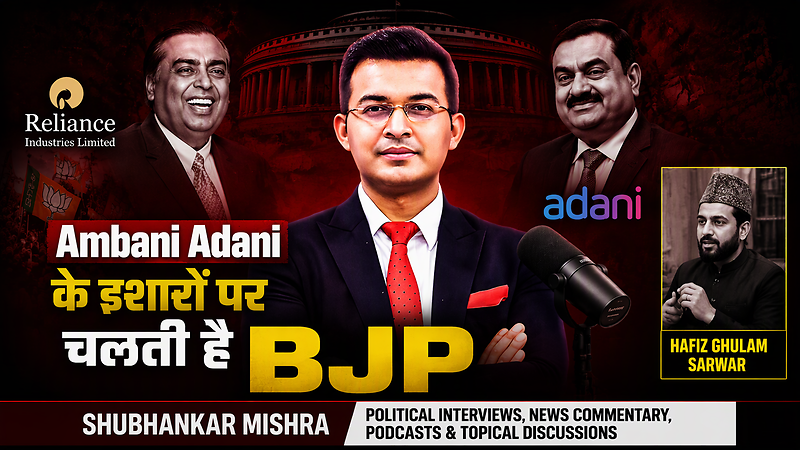
The debate surrounding the influence of billionaires Adani and Ambani on Indian politics has intensified, with various voices weighing in on whether these tycoons are mere puppeteers of the ruling Bharatiya Janata Party (BJP) or a reflection of the broader issue of wealth concentration in the country.
Shubhankar Mishra, a popular YouTuber, highlights the concerns of opposition parties who accuse the BJP of operating under the influence of Ambani and Adani. In his video, he points out that 'opposition parties accuse BJP of operating under Ambani and Adani's influence,' noting that Akhilesh Yadav has sent an associate of Ambani to the Rajya Sabha. Mishra argues that this representative, who has ties to the Gujarat Cricket Association and the BJP, underscores the close relationship between the business tycoons and the ruling party.
In contrast, Ulta Chasma's Pragya Mishra asserts that the real issue is the alarming concentration of wealth in the hands of a few individuals. She echoes the sentiments of Rahul Gandhi, stating that 'the entire wealth has been handed over to Adani and Ambani.' She argues that this shift has left farmers without their rights and youth without jobs, as 'no jobs are being provided' in a country where 'farmers are not receiving their rights or sufficient economic support.' This perspective aligns with the notion that the economic landscape is skewed, favoring the rich while neglecting the majority.
While both perspectives acknowledge the influence of Adani and Ambani, they diverge on the implications of this influence. Mishra focuses on the political ramifications, suggesting that the BJP's governance is compromised by corporate interests. On the other hand, Pragya Mishra emphasizes the socio-economic consequences, arguing that the focus should be on how this concentration of wealth impacts everyday citizens.
The voices in this debate highlight a critical tension: is the issue primarily political, involving the manipulation of governance by powerful business figures, or is it a broader economic concern reflecting systemic inequalities? Both creators provide compelling arguments that challenge the status quo, yet they approach the issue from different angles. This divergence suggests a complex interplay between political power and economic disparity in contemporary India.
Ultimately, the question remains: are Adani and Ambani simply emblematic of a political system that has been co-opted by wealth, or do they represent a larger trend of economic consolidation that threatens the fabric of Indian society? As the debate unfolds, it becomes clear that the influence of these business magnates is a multifaceted issue that deserves continued scrutiny and discussion.