Are India's Democratic Institutions Under Siege?
Nov 3, 2026, 17:00 IST
Summary
The debate on India's democratic institutions features starkly contrasting views. The Wire highlights institutional degradation, while others question the transparency of electoral processes. BJP leader Murli Manohar Joshi emphasizes constitutional integrity, contrasting with Rahul Gandhi's assertion of destroyed democracy. Yogendra Yadav and Harsh Vardhan Tripathi discuss the nature of regime change, adding complexity to the discourse. Devendra Fadnavis claims opposition actions undermine institutions.
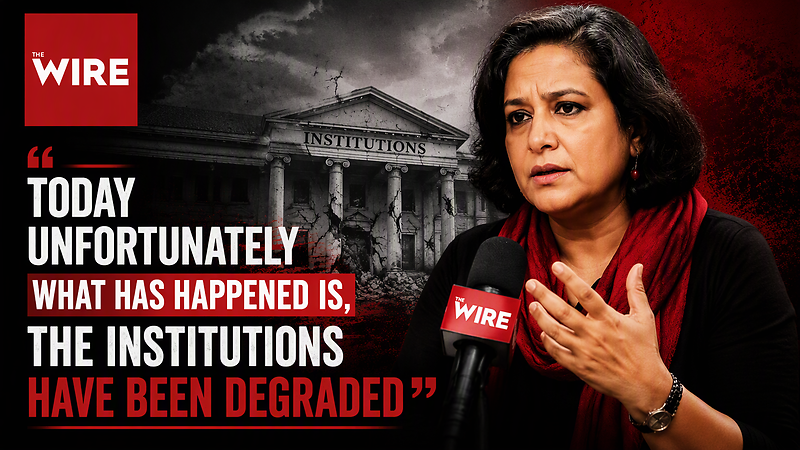
The debate over the state of India's democratic institutions has intensified, with voices from various quarters raising concerns about their weakening. The Wire, a prominent news outlet, emphasizes that 'today, unfortunately, what has happened is, the institutions have been degraded.' They argue that reductions in the status, tenure, and salaries of information commissioners have severely undermined the effectiveness of these institutions. The report highlights that the Central Information Commission operated with only three commissioners for nearly two years, leading to significant court backlogs and a lack of basic information availability.
In contrast, another piece from The Wire questions whether the Election Commission's recent actions are reinforcing or undermining democratic structures. The creator asserts that the Special Intensive Revision of electoral rolls lacks publicly disclosed supporting data, with the Election Commission subjecting eight crore people to verification without providing figures on infiltrators. This lack of transparency raises doubts about the integrity of the electoral process, furthering the argument that democratic institutions are indeed weakening.
Adding to the discourse, BJP leader Murli Manohar Joshi asserts that democracy relies on fair elections, accountable governments, and transparent bureaucracies. He insists that constitutional violations must be scrutinized by the Supreme Court, emphasizing the need for responsible opposition parties. This perspective indicates a belief that while institutions may face challenges, they are not irreparably damaged if they function within constitutional frameworks.
Conversely, Rahul Gandhi, a significant political figure, vehemently claims that 'democracy, the Election Commission have been destroyed' in India. He calls for a collective movement to restore true democratic governance, asserting that the Constitution has been set aside. This stark assertion highlights a deep concern among opposition leaders regarding the erosion of democratic principles.
In a more analytical vein, Yogendra Yadav discusses the nature of regime change and resistance within a democracy. He contends that India's historical transitions have always occurred through democratic means, implying that current protests and calls for change should also respect this framework. Yadav's insistence that electoral democracy must be preserved adds a layer of complexity to the ongoing debate, suggesting that while frustrations exist, the solutions should not stray from democratic processes.
On the other hand, Harsh Vardhan Tripathi argues that protests aimed at regime change must be differentiated from resistance within existing democratic structures. He insists that the current government can only be removed through elections, not street protests, framing the ongoing unrest as potentially misguided. This perspective counters the views of those advocating for more immediate, disruptive forms of change.
Finally, Devendra Fadnavis critiques the opposition, claiming they are systematically undermining constitutional institutions, such as the RBI and the Election Commission. He alleges that such actions serve a broader agenda of promoting an extreme-left system, thus framing the opposition's concerns as part of a conspiratorial narrative against established institutions.
Overall, the debate encapsulates a spectrum of opinions on the status of India's democratic institutions, with some asserting a significant decline while others call for a measured approach to reform and resistance. The tension between maintaining institutional integrity and addressing perceived failures continues to shape the political landscape in India.