Are Muslims More Than Just a Vote Bank? Owaisi Sparks Debate
Nov 7, 2026, 01:30 IST
Summary
Asaduddin Owaisi sparks a debate on the political representation of Muslims in India, arguing they are treated merely as a vote bank. He criticizes the BJP for denying Muslim candidates election tickets and questions the Samajwadi Party's commitment to Muslim leadership. Owaisi's remarks highlight the need for greater political agency and representation for Muslims beyond electoral participation.
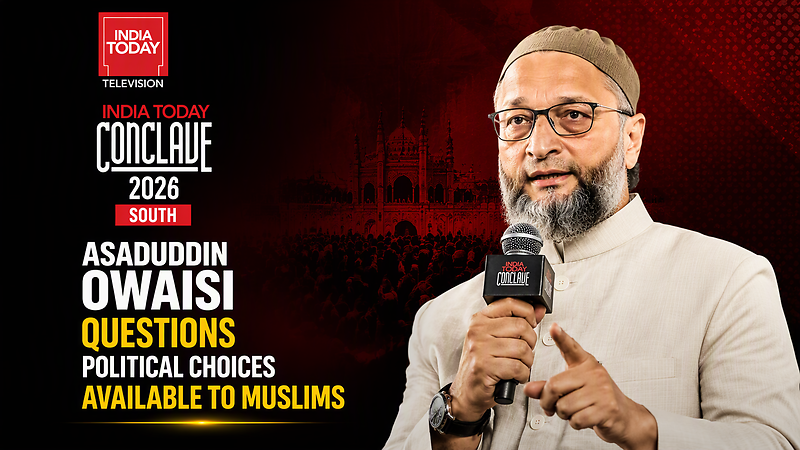
Asaduddin Owaisi, the leader of the All India Majlis-e-Ittehad-ul-Muslimeen, has ignited a significant debate regarding the political representation of Muslims in India. Speaking at the India Today Conclave 2026 South, Owaisi emphasized that Muslims have historically voted for parties out of a lack of alternatives, stating, 'Muslims hold only 4% of representation in the Lok Sabha.' He criticized the Bharatiya Janata Party (BJP) for not offering election tickets to Muslim candidates, with the exception of a single instance in Kerala, and expressed concern that other political parties treat Muslims merely as voters, thereby marginalizing them politically.
In a different context, during an interview with CNN News 18, Owaisi further elaborated on the issue by questioning the intentions of the Samajwadi Party (SP) and the Congress Party. He claimed, 'Samajwadi Party's history shows it never wanted Muslims to become political leaders.' Owaisi pointed out that despite the SP's claims of being secular, they have historically discouraged Muslim leadership. He also highlighted the recent visits of political leaders, noting that Akhilesh Yadav met with Azam Khan shortly after Owaisi's speech, which he viewed as a stark contrast to their treatment of Muslim leaders.
Both perspectives from Owaisi converge on the idea that Muslims are treated as a mere voting bloc rather than as individuals with rights and leadership potential. He argued that if Muslims continue to be seen only as voters, their social, political, and educational issues will remain unaddressed. Owaisi's insistence that Muslims should strive for more than just electoral participation underscores a broader call for political agency among the community.
Moreover, Owaisi brought attention to the historical injustices faced by Muslims in Uttar Pradesh, noting that over 700 mosques and cemeteries have been demolished during the tenure of Chief Minister Yogi Adityanath, with the Muslim community bearing the brunt of these actions. This point serves to illustrate the urgent need for political representation that goes beyond mere voting.
The debate surrounding Owaisi's assertions reflects a larger conversation about the political identity of Muslims in India. While he criticizes the current political landscape for its lack of genuine representation, it raises the question of what concrete steps can be taken to ensure that Muslims are not just viewed as a vote bank but as active participants in shaping their political future. Owaisi's advocacy for Muslim leadership challenges existing narratives and calls for a reevaluation of how political parties engage with the community, emphasizing the necessity for a more inclusive political framework that recognizes the rights and aspirations of Muslims as citizens, not just voters.