Article 370: A Clash of Perspectives on Integration and Autonomy
Nov 3, 2026, 17:30 IST
Summary
The debate over Article 370 highlights a divide between advocates for integration, represented by Faye D'Souza, who praises the film 'Article 370' for showcasing national unity, and critics like Dr. Qamar Cheema, who emphasizes the need for autonomy and democratic processes. Cheema questions the coherence of political figures like Farooq Abdullah, suggesting a need for clarity in Kashmir's future.
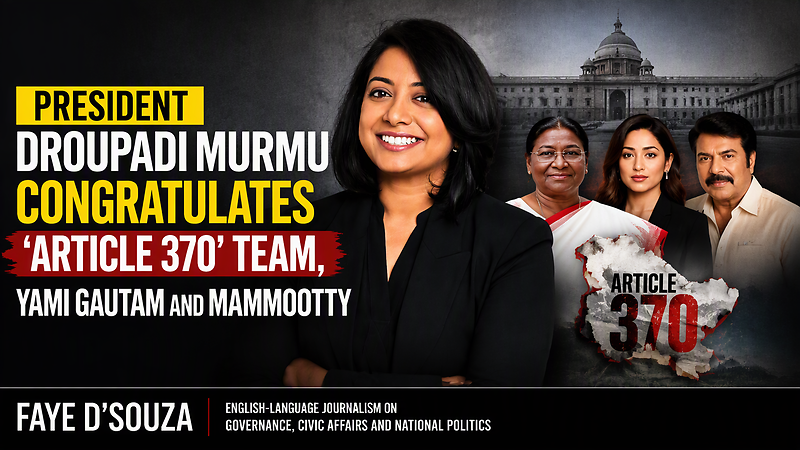
The debate surrounding Article 370 and Jammu and Kashmir's (J&K) status continues to evoke strong opinions, highlighting a significant divide between those advocating for integration and security versus those seeking statehood and autonomy. Popular influencer Faye D'Souza discusses the recognition of the film 'Article 370', which won Best Feature Film for its portrayal of national unity challenges, suggesting a positive narrative around the government's stance on integration. D'Souza emphasizes the film's role in showcasing the efforts of Prime Minister Narendra Modi in fostering unity, stating, 'This film presents a vivid account of serious challenges related to national unity and their solutions.'
On the other hand, D'Souza also highlights Yami Gautam Dhar's performance in the same film, which earned her the Best Actress award. She notes that Gautam Dhar's portrayal of a committed officer reflects 'sensitivity, courage, and compassion,' reinforcing the narrative of governance under the current administration. This dual recognition of the film and its actors suggests a broader acceptance of the government's policies, at least within certain circles.
Contrastingly, Dr. Qamar Cheema, a commentator on global politics, offers a critical view of the ongoing discourse around Kashmir's status. In his analysis, he argues that the political narrative should not solely align with the Indian government's perspective. Cheema points out that while Sheikh Abdullah's writings acknowledged Kashmir's accession to India, he questions the legitimacy of this claim, suggesting that Pakistan has historically defended Kashmir's cause. He states, 'Pakistan is described as protecting Kashmir’s cause while India’s central government remains silent.'
Cheema further critiques the shifting statements of Farooq Abdullah, a prominent Kashmiri politician, questioning the coherence of his position regarding Kashmir's autonomy and Pakistan's role. He insists that Abdullah should clarify whether he supports the restoration of statehood or simply wants to criticize the Indian government while participating in it. 'If he believes in Pakistan's support for Kashmiris, then he should resign from his government position,' Cheema argues.
This tension between the narratives of integration and autonomy reveals a deeper conflict. While D'Souza's perspective celebrates the government's efforts to unify the nation through cultural representation, Cheema's arguments underline the need for democratic processes in addressing Kashmir's future. He insists that the resolution should come through voting and democratic means rather than abandoning these principles.
The debate over Article 370 and the status of Jammu and Kashmir is not merely a matter of policy but reflects the broader ideological battle over national identity and governance. The contrasting views of D'Souza and Cheema illustrate the complexities of this issue, showcasing the divergent paths envisioned for the region's future.