BJP-SAD Reunion: An Emotional Alliance or Desperate Politics?
Nov 25, 2026, 02:30 IST
Summary
The BJP-SAD reunion has sparked a debate about its impact on Punjab's 2027 elections. Sukhbir Badal argues the alliance is an 'emotional relationship' vital for Punjab's development, while Daljit Singh Cheema highlights its historical successes. Critics question the reunion's motives, viewing it as a desperate measure for political survival amid Punjab's challenges under AAP.
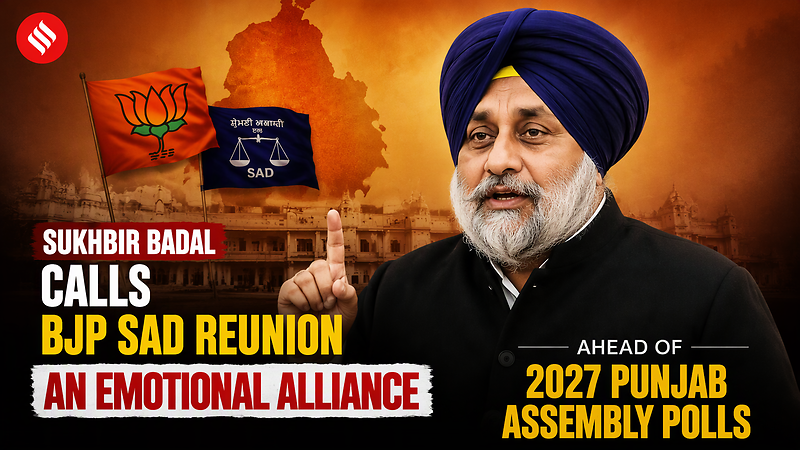
The recent reunion of the Bharatiya Janata Party (BJP) and the Shiromani Akali Dal (SAD) has ignited a heated debate about its implications for Punjab's political landscape ahead of the 2027 elections. Sukhbir Badal, a prominent leader of SAD, describes the alliance as an 'emotional relationship,' emphasizing its historical significance and its role in promoting development, peace, and communal harmony in Punjab. He asserts, 'The BJP-SAD alliance is an emotional relationship serving Punjab, India, and Sikhs,' highlighting that the partnership has been instrumental in the state's progress over the years.
Conversely, Daljit Singh Cheema, another key figure in the SAD, defends the reunion by recalling the productive 23-year partnership with the BJP, during which the two parties governed Punjab three times. He argues that their joint leadership led to substantial development, stating, 'Punjab was much better during our alliance.' Cheema also points out that the Akali Dal's departure from the National Democratic Alliance (NDA) was a necessary response to the farmers' protests, as the controversial agricultural laws were ultimately withdrawn. He emphasizes the dire state of Punjab under the Aam Aadmi Party (AAP), suggesting that the current government has plunged the state into chaos, saying, 'Punjab is nearing bankruptcy amid worsening lawlessness and corruption under AAP.'
The contrasting views highlight a significant divide in the narrative surrounding the BJP-SAD alliance. While Badal and Cheema focus on the positive historical aspects and the potential for future cooperation, critics question the motives behind the reunion. They argue that the alliance appears to be a desperate move by the SAD, which is perceived as fighting for its political survival after experiencing electoral setbacks. Opponents claim that the reunion is a sign of the Akali Dal's diminishing relevance, suggesting that it is a 'desperate alliance' formed out of necessity rather than genuine partnership.
The debate intensifies as Cheema counters these criticisms by asserting that the reactions from opposing parties indicate their fear of the BJP-SAD alliance. He states, 'When opposition parties react this way, it shows how threatened they feel by our unity.' This assertion indicates a belief that the reunion could galvanize support and potentially reshape the political dynamics in Punjab.
As the 2027 elections approach, the implications of this alliance remain uncertain. Both the BJP and SAD maintain that their historical collaboration has benefitted Punjab significantly, while critics remain skeptical about the sincerity of this reunion. With Punjab's political climate becoming increasingly polarized, the upcoming elections will be a crucial test of the BJP-SAD alliance's effectiveness and public reception.