Calls for Court-Monitored SIT Amidst Allegations of Police Excesses
Oct 13, 2026, 14:26 IST
Summary
The debate over police conduct during NEET protests in Delhi has sparked calls for a court-monitored SIT to investigate allegations of excessive force. Sakshi Joshi emphasizes the need for accountability, while Barkha Dutt highlights the Supreme Court's role in reviewing crowd control measures. Meanwhile, Pragya Mishra notes the court's recognition of students' constitutional rights amidst conflicting views on judicial intervention.
The ongoing debate surrounding police conduct during protests has intensified, particularly in light of the recent events involving NEET students in Delhi. Prominent voices are calling for a court-monitored Special Investigation Team (SIT) to investigate allegations of excessive force by the police.
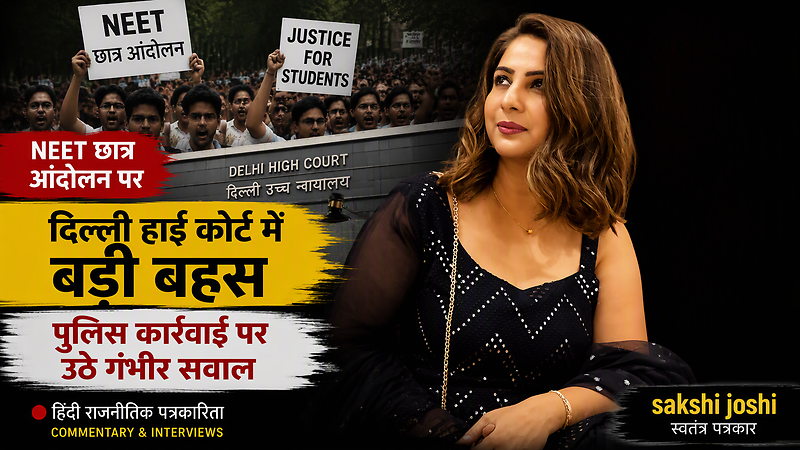
Sakshi Joshi, a journalist, presents a damning account of the police's actions, stating, "Delhi Police and RAF personnel allegedly used excessive force against NEET protesters." She highlights a specific incident involving DCP Sandeep Lambha, who, according to her, "slapped a woman after the crowd dispersed," underscoring the need for accountability. Joshi argues for the establishment of an SIT, alongside FIRs and disciplinary actions against the involved officers, asserting that without judicial intervention, police brutality may continue unchecked.
In contrast, Barkha Dutt, a prominent journalist, addresses the Supreme Court's role in reviewing crowd control measures, particularly the use of pellet guns. She notes, "The Supreme Court is reconsidering rules governing pellet-gun use for crowd control," after a 19-year-old protester suffered an eye injury from such a weapon. Dutt calls attention to the Supreme Court's efforts to clarify FIR registration amidst allegations of police violence, emphasizing the gravity of the situation.
Adding another layer to the debate, Dutt also reported on a Delhi Police officer who was nearly lynched during protests. A student, Kile, shared that his father, a police officer, was attacked while attempting to manage a volatile crowd. This incident complicates the narrative, suggesting that while police may have acted excessively, they too face significant risks during such events.
Ishkaran Singh Bhandari, a legal commentator, emphasizes the importance of preserving evidence from the protests. He notes that the Supreme Court has ordered the preservation of all CCTV and drone footage, which will be crucial for any investigation into the injuries sustained by both protesters and police. Bhandari suggests that the court's actions demonstrate a commitment to a fair inquiry, stating, "The court has extended notices to states like Madhya Pradesh and Assam to address the issues that arose during protests."
Meanwhile, Pragya Mishra from Ulta Chasma reports that the Supreme Court has expressed its discontent with police actions, indicating that "the court has said that students' protests were entirely peaceful and that they have the constitutional right to protest." The court has directed action against those who used excessive force and mandated the release of under-18 protesters without criminal records. This aligns with Joshi's calls for accountability and disciplinary measures against police officers.
However, not all voices in this debate are in agreement. Some argue that the Supreme Court has been dismissive of the issues at hand. Mishra notes that the Chief Justice-led bench declined to intervene in police actions, stating, "The Supreme Court said, 'Do not waste our time.'" This sentiment raises concerns about the judiciary's willingness to engage with these critical issues, as the court appears to prioritize efficiency over justice for protesters.
As the debate continues, the voices of both protesters and police officers reveal a complex landscape where calls for accountability and justice intertwine. The establishment of a court-monitored SIT may offer a path forward, but it remains to be seen whether the judiciary will take the necessary steps to address these grievances comprehensively.