Can Courts Remedy Flawed Voter-Roll Processes? A Divided Debate
Nov 4, 2026, 14:44 IST
Summary
The debate on whether courts can fix flawed voter-roll processes features diverse perspectives. Kapil Sibal highlights the Supreme Court's need for factual examination, while Justice Madan Lokur calls for constitutional limits on the ECI's powers. Concerns about mass voter removals and procedural biases dominate the discussion, with calls for judicial scrutiny and expedited hearings gaining traction among political leaders.
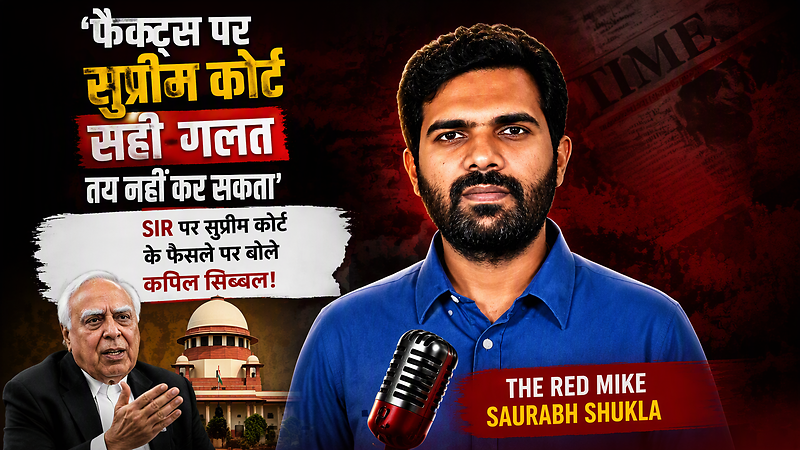
The question of whether courts can rectify a flawed voter-roll process has sparked intense debate among various voices, each presenting compelling arguments regarding the role of the Election Commission of India (ECI) and the Supreme Court's involvement.
Kapil Sibal, a prominent lawyer and politician, argues that the Supreme Court cannot determine the factual correctness of the Special Intensive Revision (SIR) without examining the underlying facts. In a discussion, he stated, "The Supreme Court has declared that the exercise is correct without considering the facts. This is a factual exercise, not a legal one," highlighting the need for both substantive and procedural reasonableness in constitutional matters.
Sibal further elaborated on alleged manipulations within the voter-roll process, claiming, "A BLO received directions to remove Muslim names from electoral rolls," suggesting that this manipulation aimed to skew voting demographics in favour of a particular group. He emphasized that such actions undermine the electoral process's integrity.
In a related perspective, Justice Madan Lokur raised concerns about the ECI's administrative overreach. He argued that while the ECI has vast powers under Article 324 to supervise elections, there should be constitutional limits to prevent it from overstepping its role, stating, "A red line has to be drawn somewhere" to maintain the balance of power.
Abhisar Sharma, another commentator, voiced alarm over the SIR's implications, noting that "millions are being removed from voter lists" and that the appeals process is cumbersome. He criticized the rapid verification of high-profile individuals' names while countless others languish without representation, suggesting a systemic bias in the process.
The Supreme Court has also begun to scrutinize the ECI's actions. In recent proceedings, the Court questioned the basis for issuing notices to 33 lakh voters, demanding clarity on discrepancies and the rationale behind such sweeping removals. Justice Ujjal Bhuyan underscored the gravity of the situation, asserting that processes removing citizens' voting rights are "unjustifiable" and violate constitutional principles.
Faye D'Souza, a journalist, echoed these sentiments, urging the Supreme Court to expedite cases related to the SIR and other electoral malpractices, emphasizing that delays could harm public interests. Similarly, Shashi Tharoor, a politician, called for a thorough examination of the serious malfeasance in the SIR process, pointing out that many families, including those who previously voted for the BJP, have found themselves inexplicably removed from the rolls.
Asaduddin Owaisi, president of AIMIM, has also joined the fray by filing a petition against the SIR, requesting a joint hearing with other ongoing petitions related to the process's alleged irregularities. His involvement signals a growing concern among political leaders about the integrity of the electoral system.
On the other hand, some creators argue that the ECI's reliance on digital systems, like ECI-Net, could complicate matters further. Barkha Dutt pointed out that while the ECI claims Form 6 remains unchanged, the digital requirements might impose new conditions that could affect voters' registration processes.
In conclusion, the debate surrounding the courts' ability to fix the flawed voter-roll process is marked by a spectrum of opinions. While many advocate for judicial intervention to protect citizens' voting rights, others caution against potential overreach by the ECI. As the Supreme Court continues to investigate these matters, the outcome remains pivotal for the future of electoral integrity in India.