Caste Census and Quota Politics: Who is Manipulating Whom?
Nov 26, 2026, 22:19 IST
Summary
The debate on caste census and quota politics in India reveals differing perspectives. Sakshi Joshi criticizes the tribunal bill for lacking reservations for marginalized communities, while Ajeet Bharti highlights the BJP's loss of support over reservation promises. Sanjay Dixit calls for unchanged reservation provisions until equality is achieved, and Yogendra Yadav questions the census process's design, advocating for consensus before proceeding.
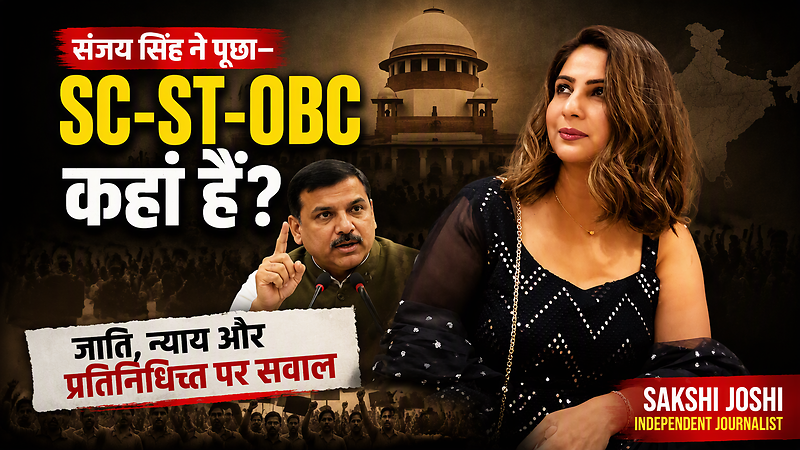
As India navigates the contentious waters of caste census and quota politics, voices from various corners weigh in on the implications and motivations behind the government’s approach. Sakshi Joshi, a prominent political commentator, passionately argues against the tribunal bill, highlighting that it fails to include reservations for Dalits, Adivasis, and backward classes. She points out that out of India's ten-crore tribal population, only one has served as a Supreme Court judge, questioning the government’s commitment to inclusivity in higher judicial appointments. Joshi states, “The tribunal bill does not specify reservations for Dalits, Adivasis and backward classes.”
On the other hand, Ajeet Bharti, a political analyst, suggests that the ruling Bharatiya Janata Party (BJP) is losing touch with its traditional support base over reservation politics. He claims that recent AI-generated videos portraying Amit Shah as promising to abolish reservations have stirred discontent. He asserts, “The government has sidelined its own loyal base,” as it attempts to win back support through a perceived commitment to social justice.
Contrasting with Joshi's perspective, Sanjay Dixit from The Jaipur Dialogues insists that the constitutional provisions for reservation should remain unchanged until true social equality is achieved. He emphasizes that the purpose of reservation is to promote equality, stating, “Reservation should continue until social equality is achieved.”
Arfa Khanum Sherwani, a social commentator, brings a nuanced angle to the debate by discussing the implications of patriarchal structures within caste politics. She argues that the Manusmriti's influence on societal norms has adversely affected upper-caste women, suggesting that figures like Rahul Gandhi, by opposing Brahminism and the Manusmriti, could attract a wider audience. She notes, “Manusmriti became more dangerous when religious texts turned into public opinion.”
Yogendra Yadav, a political strategist, raises concerns about the government's handling of the caste census. He argues that the upcoming census should be suspended until there is a consensus among political parties on its format. He warns that once the enumeration begins, it may become impossible to alter the format, stating, “If there is no consensus, there is no census.” Yadav further criticizes the BJP for its historical opposition to caste census initiatives, despite past commitments, and highlights the importance of documenting the privileges of higher castes alongside measuring disadvantages faced by OBCs.
The debate reveals a complex interplay of motivations and implications surrounding caste politics in India. While Joshi and Yadav emphasize the need for inclusivity and transparency in caste enumeration, Bharti and Dixit reflect on the shifting political loyalties and the role of historical context in shaping current policies. As the discussion unfolds, it remains to be seen who will ultimately benefit from these political maneuvers and whether genuine social justice can be achieved in the process.