CIA Funding and Pakistan Ties: Conspiracy Theories Surrounding the RSS
Nov 6, 2026, 11:31 IST
Summary
The debate on the RSS involves Ashok Kumar Pandey, who argues that CIA funding aimed to weaken India, asserting that the RSS was identified as a key player. In contrast, journalist Sandeep Deo claims the RSS has links to Pakistan's ISI and corruption allegations, suggesting a dual threat of foreign influence and domestic extremism. Both perspectives highlight serious concerns regarding the organization's integrity.
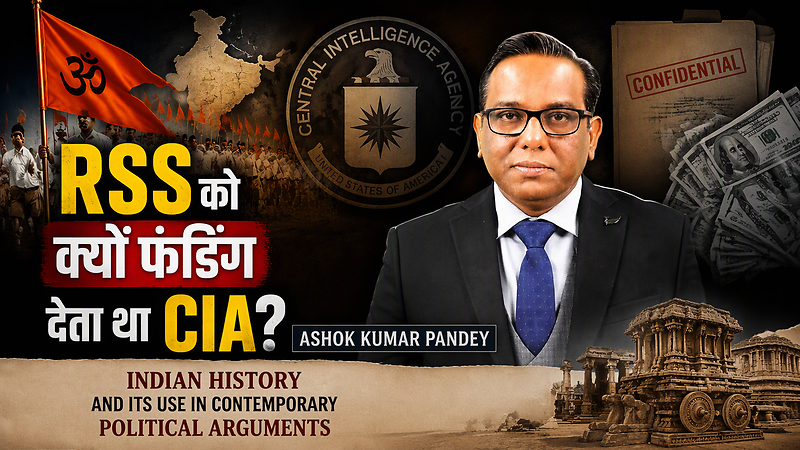
The debate surrounding the Rashtriya Swayamsevak Sangh (RSS) is heating up, with various content creators presenting differing perspectives on alleged CIA funding and supposed connections to Pakistan. Ashok Kumar Pandey, a YouTuber known for his historical analysis, claims that the CIA began systematically funding the RSS after 1962, arguing that this was part of a broader strategy to weaken newly independent nations during the Cold War. He asserts that US strategists identified the RSS as a force capable of undermining India's nation-state, stating, 'Systematically, American funding to the RSS occurred to weaken the Indian nation-state.' Pandey emphasizes that the US sought to exploit internal divisions within India, framing the RSS as a tool in this effort.
In contrast, Sandeep Deo, a journalist and popular YouTuber, shifts the focus to allegations of the RSS's connections with Pakistan's Inter-Services Intelligence (ISI). He references multiple individuals linked to both the BJP and alleged Pakistani operatives, claiming that prominent RSS figures like Mohan Bhagwat have faced accusations regarding these ties. Deo argues, 'Mohan Bhagwat and Indresh Kumar faced allegations of links to Pakistan’s ISI,' suggesting that such connections could compromise national security. He further critiques the RSS's alleged involvement in extremism, stating that the organization has deep relationships with radical elements.
Deo's perspective introduces a different layer to the debate, positing that while the CIA's funding may have aimed to weaken India, the RSS's alleged connections to Pakistan complicate the narrative. He insists that this duality of foreign influence and internal extremism presents a serious threat to India, claiming, 'These are indeed extremist people,' which positions the RSS as not only a domestic concern but also a national security issue.
Additionally, in another video, Deo expands on corruption within the RSS, specifically concerning the Ram temple construction. He alleges that RSS members took significant commissions on materials, stating, 'RSS members allegedly took 40% commissions on Ram temple construction materials.' This assertion adds a layer of corruption to the existing conspiracy theories, questioning the integrity of the organization.
The discourse reveals a complex web of accusations, with Pandey highlighting foreign intervention through CIA funding and Deo addressing the implications of alleged internal extremism and corruption. While both creators agree on the problematic nature of the RSS, they diverge in their focus: Pandey emphasizes external manipulation, while Deo underscores internal affiliations with extremist groups and corruption. This multi-faceted debate illustrates the contentious and often conspiratorial landscape surrounding the RSS, as both creators challenge the organization's legitimacy from different angles.