Contrasting Views on the Godhra 2002 Incident: Staged Violence or Political Conspiracy?
Oct 24, 2026, 21:00 IST
Summary
The debate on the Godhra 2002 incident reveals contrasting views. The Ranting Gola claims the violence was staged to empower the BJP, while Shubhankar Mishra blames the Congress for allowing Modi's rise. Both creators highlight political manipulation surrounding the event, questioning accountability and the narratives that persist in contemporary discourse.
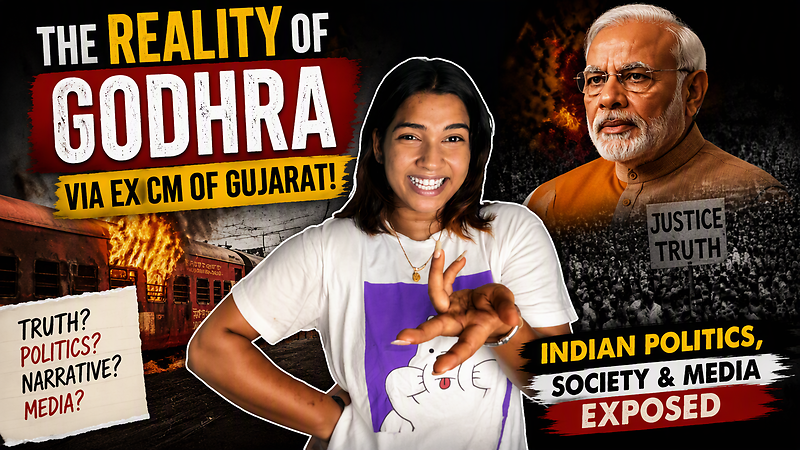
The 2002 Godhra incident continues to evoke intense debate, particularly regarding its implications for communal tensions in India. Two distinct perspectives emerge from content creators discussing the former Chief Minister's account of the events.
Youtuber The Ranting Gola argues vehemently that the violence in Godhra was not a spontaneous eruption but a carefully orchestrated act aimed at inciting communal riots. He claims, 'Godhra violence was staged to provoke communal riots, not spontaneous.' He insists that the fire in the train coach was ignited from within, not from outside, implying a calculated effort to manipulate public sentiment against Muslims. Gola suggests that this act was part of a broader conspiracy to instill fear among Hindus, thereby empowering the Bharatiya Janata Party (BJP) in Gujarat. He goes further to assert, 'This was a conspiracy to bring the BJP to power in Gujarat.' His perspective raises questions about the motivations behind the incident and the role of political actors in exacerbating communal divides.
In contrast, Shubhankar Mishra, a popular influencer, shifts the blame towards the Congress party, claiming that their inaction allowed figures like Narendra Modi and Amit Shah to rise politically. He states, 'Congress's failure to prosecute Narendra Modi and Amit Shah enabled their political rise.' Mishra argues that the perpetrators of the Godhra fire were never identified, leading to a lasting narrative that Muslims were responsible. He contends, 'If it could be established who set the fire, the narrative could have changed.' By framing the Congress party as the principal villain, Mishra challenges the notion that the BJP's rise was solely due to its own actions, instead suggesting it was facilitated by its political opponents' failures.
Both creators, while diverging in their focus, highlight the perceived manipulation of narratives surrounding the Godhra incident. Gola's assertion of a deliberate staging contrasts with Mishra's emphasis on political negligence, yet both agree that the truth about the incident remains obscured by political machinations. The debate also underscores a broader discussion about accountability in political violence, where Gola criticizes the BJP's role in the events and Mishra points to the Congress party's complicity.
As the discourse continues, the differing interpretations of the Godhra incident reflect deeper tensions in Indian society, with each voice contributing to an evolving narrative about responsibility and truth in the context of communal violence. The legacy of Godhra remains a touchstone for discussions about political power, accountability, and communal relations in India, illustrating how history can be interpreted through varying lenses depending on political affiliations and perspectives.