Debate Erupts Over Governor's Rule in Khyber Pakhtunkhwa
Oct 12, 2026, 16:30 IST
Summary
The debate over Governor's rule in Khyber Pakhtunkhwa features contrasting views. Najam Sethi warns of a potential national emergency due to security failures, while Dr. Qamar Cheema highlights the provincial government's inability to protect citizens. Sajid Tarar supports Governor's rule for stability, advocating for effective governance. The discussions reveal deep concerns over political accountability and security challenges.
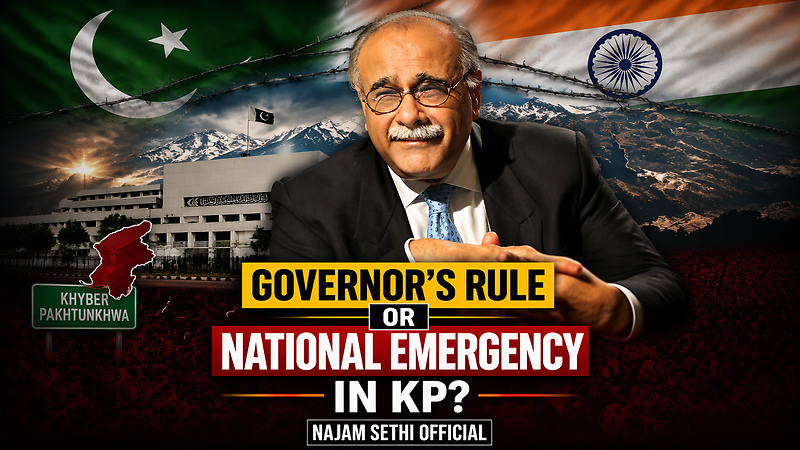
The ongoing debate regarding the imposition of Governor's rule in Khyber Pakhtunkhwa has sparked intense discussions among various commentators. Najam Sethi, a prominent political commentator, suggests that Pakistan may impose a national emergency rather than merely implementing Governor's rule. He argues that the situation in Khyber Pakhtunkhwa is dire, citing a lack of cooperation from the provincial government in counterterrorism efforts. He claims, 'The Khyber Pakhtunkhwa government is accused of withholding counterterrorism cooperation from Islamabad,' highlighting the severity of the security issues that necessitate federal intervention.
In contrast, Dr. Qamar Cheema, a political analyst, believes that the federal government is considering Governor's rule as a means to preserve the provincial government amid increasing unrest. He asserts that the Pakistan Tehreek-e-Insaf (PTI) government has failed to protect its citizens, noting, 'Khyber Pakhtunkhwa residents view the government as unable to provide protection.' He further critiques the provincial leadership for allowing the Tehrik-i-Taliban Pakistan (TTP) to operate within the province, stating, 'PTI allegedly permitted TTP offices and released over 200 Taliban prisoners.'
Adding to the discourse, Sajid Tarar, another commentator, supports the imposition of Governor's rule, framing it as a necessary step for restoring stability. He contends that emergency measures in Khyber Pakhtunkhwa are justified under Articles 232 and 234 of Pakistan's Constitution, emphasizing that 'Governor’s rule in Khyber Pakhtunkhwa is justified for stability and law enforcement.' He also expresses optimism about the appointment of a new Chief Secretary, arguing that it signals a positive change in governance.
Dr. Cheema echoes some of Tarar's sentiments, indicating that the situation has reached a critical point where federal oversight is essential. He criticizes the current Chief Minister, suggesting that neglect of official duties has led to a governance crisis, stating, 'The chief minister allegedly ignored office for a month, worsening Khyber Pakhtunkhwa's governance.' This sentiment of frustration with provincial leadership is shared by others, who question the effectiveness of the PTI government in addressing the region's security challenges.
However, there are nuances in the debate. While Sethi warns against a prolonged national emergency, fearing it could destabilize the entire country, Cheema and Tarar focus on the immediate need for effective governance to tackle terrorism and lawlessness. Tarar asserts, 'We cannot allow TTP and BLA to become stronger; we must act before they escalate their activities.'
As this debate unfolds, the perspectives reveal a complex interplay of political accountability, security concerns, and the urgent need for effective governance in Khyber Pakhtunkhwa. Each commentator brings a unique angle to the discussion, reflecting the multifaceted nature of the challenges facing the province and the country at large.