Does Trump Truly Desire Peace? A Closer Look
Oct 28, 2026, 18:30 IST
Summary
Sharan Hegde argues that Donald Trump's geopolitical strategies prioritize self-interest over genuine peace. He suggests that Trump's focus on control, particularly regarding energy independence from Russia, undermines any claims of seeking harmony. Hegde also reflects on the necessity for adaptation in both politics and business, highlighting the complexities of Trump's foreign policy.
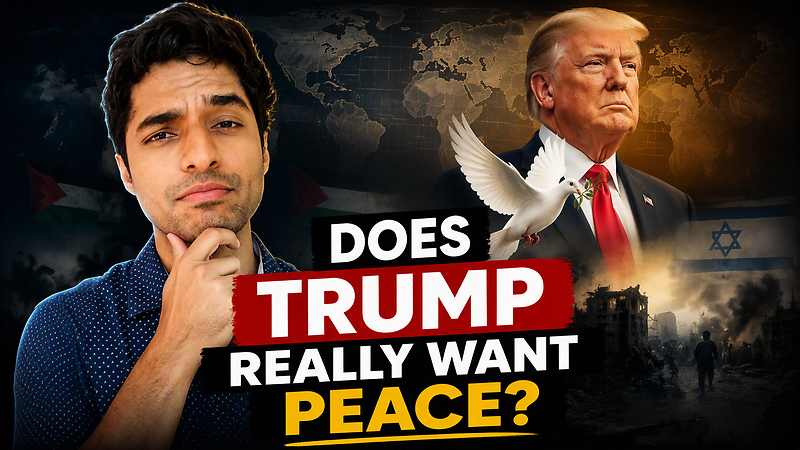
The question of whether former President Donald Trump genuinely seeks peace has sparked contrasting views among content creators. Sharan Hegde, a popular YouTuber, argues against the notion that Trump wants peace, suggesting instead that his geopolitical maneuvers are driven by self-interest.
In a video titled "Why Trump Doesn’t Want Peace," Hegde contends that Trump's approach to foreign policy is more about exerting control than fostering harmony. He explains that Trump aimed to gain leverage over Venezuela and sought to make Europe independent from Russian energy. Hegde claims, 'The incentive for US to weaken Russia is basically to make the world dependent on exporting oil from its own country.' This assertion highlights a broader strategy where peace is secondary to economic and territorial gains.
Hegde further discusses the rhetoric surrounding US territorial claims, stating, 'They are saying Mexico is also our territory, Canada is also ours, Denmark is also ours.' He interprets this as a means to create a buffer against Russian influence, indicating that Trump's strategies are less about achieving peace and more about securing American dominance.
In contrast, Hegde's earlier video, "Does Trump Really Want Peace?" does not directly address Trump's intentions but instead focuses on the challenges faced by the Indian IT sector, drawing an analogy that suggests broader implications about adaptation and relevance. He mentions that the traditional model of low-cost, high-quality service is no longer sufficient, paralleling how geopolitical strategies must evolve. While this video does not explicitly link to the peace debate, it indirectly reflects on the necessity for change in both business and political landscapes, suggesting that stagnation can lead to irrelevance.
The tension between these perspectives raises important questions. Hegde's critiques suggest that any peace Trump claims to desire may be a facade for more aggressive economic strategies. His assertions indicate that the former president's policies may serve to strengthen US power rather than promote global stability.
Ultimately, while Hegde identifies the lack of genuine peace-seeking behavior in Trump's actions, he also implies that broader geopolitical strategies require adaptation, much like the Indian IT sector must innovate to remain relevant. This duality presents a complex picture of Trump's foreign policy, challenging the simplistic view of his intentions.
In conclusion, the debate surrounding Trump's desire for peace is multifaceted, with Hegde arguing that his actions prioritize control and economic interests over genuine harmony. As the discourse continues, it is clear that the motivations behind political maneuvers require careful scrutiny to understand their true implications for global relations.