Encounter Justice: A Double-Edged Sword for the Rule of Law
Nov 23, 2026, 20:00 IST
Summary
The debate on police encounters in India reveals deep divisions. Shubhankar Mishra discusses the competitive nature of police encounters, while Sakshi Joshi argues they undermine the rule of law. Mishra's analysis of the Hyderabad encounter questions its legitimacy, and Ashok Shrivastav defends the Batla House encounter's legality, highlighting ongoing societal divides over justice and accountability.
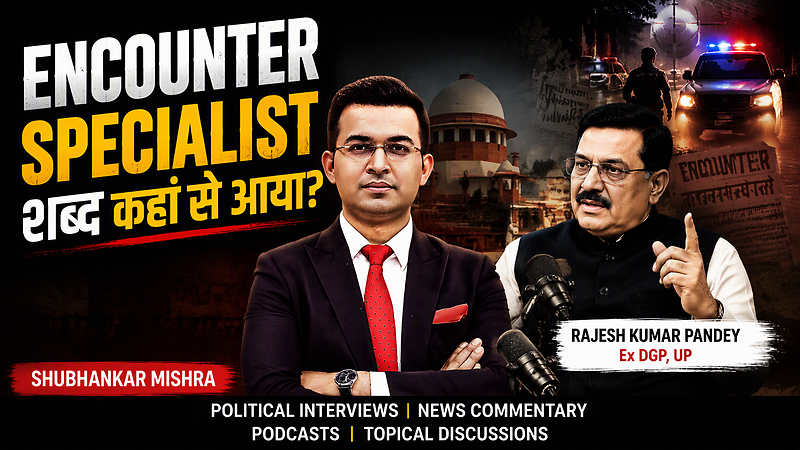
The debate surrounding police encounters in India raises critical questions about justice and the rule of law. On one side, Shubhankar Mishra, a popular YouTuber, highlights the historical context of encounters, noting that figures like Pradeep Sharma and Bhosale were responsible for numerous encounters during the 1990s. He states, 'Pradeep Sharma was credited with 101 encounters, while Bhosale had 85,' illustrating how the term 'encounter specialist' emerged in the Indian policing lexicon during this time. Mishra emphasizes the competitive nature among officers, who vied to achieve higher numbers of encounters, suggesting a troubling culture within law enforcement.
In contrast, Sakshi Joshi, a journalist, argues that encounters fundamentally undermine the rule of law. She asserts, 'Every encounter conceals the truth behind serious crimes and their wider criminal networks,' contending that the glorification of such actions by media outlets further complicates public perception. Joshi insists that the Supreme Court must intervene to ensure that encounters are only a last resort, maintaining that 'the truth should be unveiled through proper legal channels rather than through extrajudicial killings.'
Mishra further complicates the discussion with his examination of the infamous Hyderabad encounter case. He questions the legitimacy of police actions, stating, 'If police kill four people without trial and the whole country celebrates, can we call it justice?' He cites a Supreme Court commission that found the encounter staged, revealing that three of the deceased were minors. This inquiry highlights the potential for abuse of power and the dangers of mob justice that can arise from public sentiment in the absence of faith in the legal system.
Ashok Shrivastav, another content creator, references the Batla House encounter, where police killed two alleged terrorists, Atif and Sajid, while a police officer was also killed. He argues that the court upheld the legitimacy of this encounter, stating, 'The court found that Atif and Sajid were indeed terrorists involved in multiple bomb blasts.' However, he criticizes the ongoing calls for justice from groups like AISA, who demand recognition for the deceased terrorists, highlighting a societal divide on how encounters are perceived.
While Shrivastav supports encounters as necessary responses to terrorism, both Joshi and Mishra advocate for accountability and caution against a system that may prioritize quick results over due process. Joshi's insistence that 'the encounter is the end of the rule of law' resonates with Mishra's call for a more robust judicial system that can deliver justice without resorting to extrajudicial measures. The clash of perspectives reveals a society grappling with the balance between swift justice and the foundational principles of legal due process.
As these voices continue to engage in this complex debate, the future of encounter justice in India remains uncertain. The challenge lies in reconciling public safety with the imperative of justice and accountability, ensuring that the rule of law prevails over the allure of quick fixes.