Gandhi's Legacy: Secular Icon or Devout Hindu Leader?
Oct 19, 2026, 13:51 IST
Summary
The debate over Mahatma Gandhi's legacy raises questions about his identity as a secular icon versus a devout Hindu leader. Content creators from Khanversation argue for celebrating his Hinduism, while ulta chasma uc pragya mishra and Sakshi Joshi emphasize nonviolent resistance against violence. This discourse reveals the complexities of Gandhi's teachings in contemporary India.
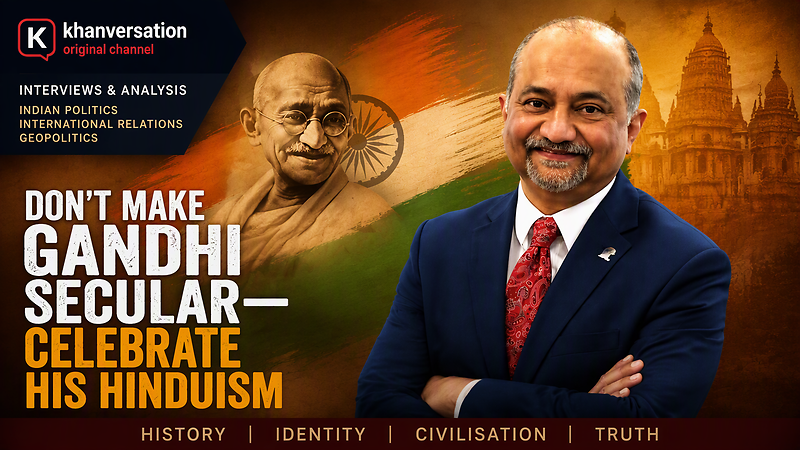
The debate surrounding Mahatma Gandhi's legacy continues to stir strong opinions, particularly regarding whether he should be celebrated as a secular figure or a deeply religious Hindu leader. Various content creators offer contrasting perspectives that highlight this tension.
Khanversation, a popular YouTube channel, presents a compelling argument in the video titled "Don't make Gandhi secular — celebrate his Hinduism." The creator asserts that Gandhi's philosophical and ethical legacy can serve as a foundation for a cultural counter-revolution in India. They emphasize, "Gandhi was deeply religious rather than a secular figure," urging that celebrating his Hinduism could act as an antidote to the rising tide of Hindutva.
In another video, also from Khanversation, titled "Ahimsa explained: nonviolent but aggressive struggle," the creator elaborates on Gandhi's principle of ahimsa, explaining that it does not equate to passive peace. They clarify that for Gandhi, ahimsa represents an intense struggle for justice and truth, maintaining that "you must pursue justice and goodness without violence in actions, words, or thoughts." This nuanced understanding of ahimsa contrasts with a more simplistic interpretation of nonviolence as mere pacifism.
Conversely, ulta chasma uc pragya mishra, a YouTuber, emphasizes the importance of Gandhi's methods in resisting violence, particularly in their video "'वो गोडसे को मानते हैं, हम गांधी को मानते हैं.'" Mishra argues that supporters of Gandhi will oppose the violent ideologies represented by figures like Nathuram Godse through nonviolent means. They stress, "We believe in Gandhi's approach; those who loot national assets are the real anti-nationals," suggesting a moral high ground in the fight against injustice.
Sakshi Joshi, another prominent YouTuber, takes a critical stance towards contemporary political figures, particularly Kiren Rijiju, in her video titled "गांधी का रास्ता छोड़ गोडसे की विचारधारा क्यों अपना रहे हैं..!." She accuses Rijiju of drifting from Gandhi's principles towards Godse's ideology, stating, "This is Gandhi's country; we will follow Gandhi's path for change." Joshi insists that India's political change should adhere to Gandhi's methods, including non-cooperation and civil disobedience, reinforcing a call to return to Gandhi's foundational principles.
Throughout these discussions, a clear divide emerges: while some creators advocate for a celebration of Gandhi's Hinduism as a source of moral guidance, others emphasize the practical application of his nonviolent resistance. Both perspectives recognize the need for justice but differ on the role of Gandhi's religious identity in shaping contemporary political discourse. The clash of views highlights the ongoing struggle to define Gandhi's legacy in a rapidly changing socio-political landscape, where interpretations of ahimsa and Hinduism are contested.
Ultimately, this debate reflects a broader conversation about how Gandhi's teachings can inform present-day activism and political thought in India, as creators grapple with the complexities of his legacy in an increasingly polarized environment.