Have India's Institutions Truly Collapsed? A Deep Dive into the Debate
Nov 1, 2026, 22:55 IST
Summary
The debate on India's institutional integrity reveals stark perspectives. Markandey Katju claims a complete collapse of institutions rooted in flawed governance. Major General Yash Mor highlights corruption among politicians, while Pooja Prasanna and Dr. Qamar Cheema voice concerns over electoral rigging. Shubhankar Mishra notes the rising misuse of investigative agencies, painting a grim picture of eroding trust in democracy.
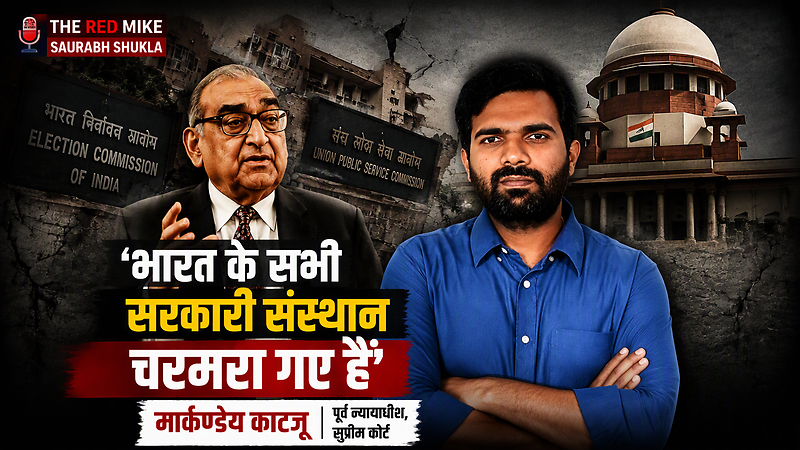
The debate surrounding the faith in India's institutions has reached a boiling point, with various voices highlighting the perceived collapse of these entities. Markandey Katju, a former Supreme Court judge, emphatically argues that 'all institutions of your government have completely collapsed,' suggesting a deep-rooted failure in the very foundation of India's democratic setup. He attributes this collapse to a departure from the original principles enshrined in the Constitution, which he believes were borrowed from Western models to uplift a feudal society.
Contrastingly, Major General Yash Mor points to systemic corruption in Indian politics, stating that the focus has shifted to monetary gains rather than ideological principles. He references a recent report from the Indian Express regarding land accumulation by the Madhya Pradesh chief minister's family, which he claims exemplifies how politicians and bureaucrats collude to benefit personally before public interests are even considered.
Echoing concerns about electoral integrity, Pooja Prasanna shares her experiences from tribal areas where villagers express a profound disillusionment with elections, claiming they are rigged. She emphasizes that politicians feel secure in their positions, expecting to win regardless of public sentiment. This sentiment of disenchantment is further echoed by Dr. Qamar Cheema, who raises alarm over alleged electoral fraud in West Bengal, particularly affecting Muslim voters. He insists that such practices necessitate fresh elections, underscoring a growing mistrust in the electoral process.
In the same vein, Shubhankar Mishra discusses the increasing misuse of investigative agencies like the Enforcement Directorate (ED) and the Central Bureau of Investigation (CBI). He argues that while political misuse has always existed, its current scale is alarming and signals a deteriorating state of democracy in India. This perspective reinforces the concerns raised by Katju regarding institutional collapse, as the misuse of power undermines public trust and the rule of law.
The convergence of these views paints a grim picture of India's political landscape, where trust in institutions is eroding rapidly. While Katju lays the blame on the foundational aspects of governance, Mor, Prasanna, Cheema, and Mishra focus on the symptoms of corruption, electoral malpractice, and the politicization of institutions. The overall narrative suggests a collective sentiment that India's democratic institutions are indeed faltering, leading to a significant loss of faith among the populace.