Heckling and Credibility: The Media's Role in the CJP Protests
Sep 13, 2026, 13:30 IST
Summary
The debate over media coverage during the CJP protests highlights diverse perspectives on credibility and accountability. Abhisar Sharma criticizes politicians for evading questions, while Ajit Anjum urges direct government engagement with protesters. Sakshi Joshi raises concerns about misrepresentation by Aaj Tak, and Barkha Dutt points to government pressure on media. Various creators emphasize the need for responsible journalism amidst the protests.
As protests erupt over the Citizenship Amendment Act (CAA) and the National Register of Citizens (NRC), a significant debate unfolds regarding the role of television news in covering these events. Content creators from various backgrounds have voiced their opinions on the credibility of media coverage, the treatment of journalists, and the interactions between protesters and news anchors.
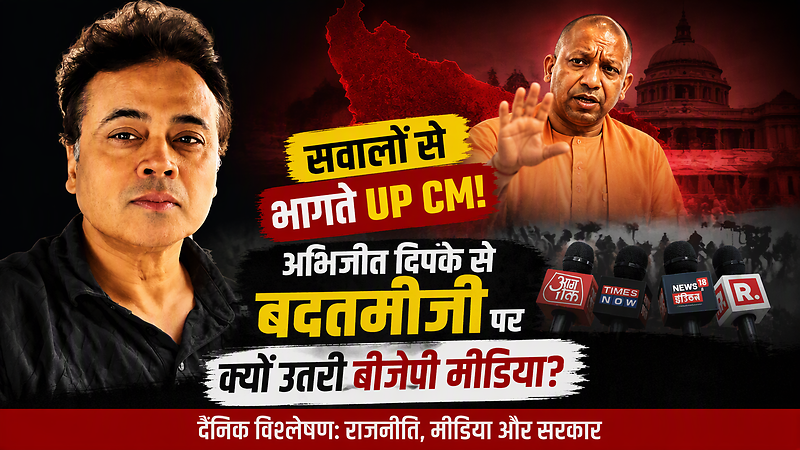
Youtuber Abhisar Sharma criticizes Uttar Pradesh Chief Minister Yogi Adityanath for leaving press conferences without addressing journalists' questions, stating, "Uttar Pradesh CM Yogi Adityanath leaves press conferences without answering journalists' questions." He highlights a recent incident where a Balaghat journalist confronted Abhijeet Dipke, accusing him of politicizing deaths after arriving late to a protest. Sharma suggests that journalism in Madhya Pradesh has become increasingly aligned with the BJP, reflecting a broader concern about media credibility during the protests.
Contrastingly, Ajit Anjum, a popular journalist, shifts focus to the responsibilities of media figures like Abhijeet Dipke. He argues that the government should engage directly with prominent protesters like Sonam Wangchuk, who has lost significant weight during a hunger strike. Anjum contends, "The government should negotiate directly with Wangchuk instead of blaming Abhijeet Dipke," indicating a frustration with how media narratives can sometimes deflect accountability from the authorities.
In a different vein, Sakshi Joshi raises alarms over Aaj Tak's alleged misrepresentation of CJP spokesperson Ramvi Chandel. She states, "Aaj Tak presented Ramvi Chandel as a CJP spokesperson despite disputed affiliation," and questions why the CJP has not clarified Chandel's status, suggesting a lack of transparency in media representations that can undermine credibility.
Mojo Story's Barkha Dutt introduces a critical perspective on how television news operates under pressure from the government. She notes that while newspapers call for action against officials like Dharmendra Pradhan, television channels often yield to external pressures regarding airtime allocation. Dutt states, "Television channels face daily pressure from the Prime Minister’s Office over airtime," indicating a compromised journalistic integrity in the face of governmental influence.
Amidst the protests, a recurring theme emerges about the treatment of journalists. Content creator Sarthak Goswami emphasizes that protesters are not targeting journalists per se but are reacting against the media outlets' representatives. He claims, "Protesters are not targeting journalists, but media outlets’ representatives and anchors’ logos," suggesting that the hostility arises from the perceived agendas of the media rather than the journalists themselves.
The protests also witnessed instances of heckling directed at journalists, as highlighted by Ajit Anjum, who reported that protesters chanted slogans against 'Godi media' during confrontations with journalists like Anjana Om Kashyap. He noted that crowds expressed their discontent towards media figures, questioning their credibility and motives.
In a humorous turn, Ulta Chasma's Pragya Mishra shared a light-hearted moment during the protests, noting how cockroaches symbolically drove away ‘Godi media’. She remarked, "A boycott of ‘Godi media’ reportedly began at the protest site," illustrating the growing frustration among protesters regarding how media covers their narratives.
As the debate around media credibility intensifies, it is clear that different voices are calling for a reassessment of how news coverage is conducted during significant social movements. Whether through criticisms of governmental influence, calls for accountability from media figures, or the rejection of perceived biases, the ongoing discourse reflects a broader struggle for truthful representation in the face of political unrest.