'Hindus in danger': Real Fear or Political Scare?
Nov 24, 2026, 14:17 IST
Summary
The debate on demographic changes in India features contrasting views. Sanjay Dixit argues that rising Muslim populations pose a national security threat, while Shubhankar Mishra counters that fears of Muslims outnumbering Hindus are unfounded and rooted in misconceptions. This discussion highlights the complexities of demographics, politics, and societal narratives in India.
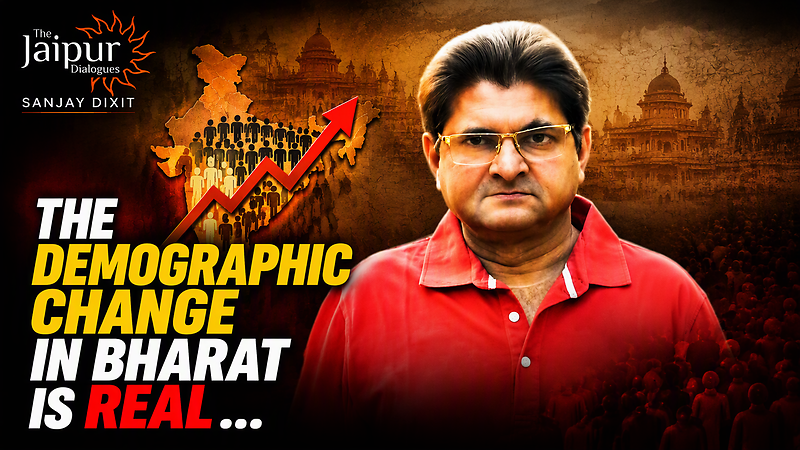
The debate surrounding the demographic changes in India has sparked a heated discussion among content creators, particularly regarding the perceived threat to Hindus. Sanjay Dixit, from the channel The Jaipur Dialogues, asserts that the demographic shift is not just a statistical concern but a pressing national security issue. He highlights that in 2011, several districts in Assam had Muslim populations nearing or exceeding 50%. Dixit warns, 'The day Hindus become a minority in their own areas, questions will no longer be allowed.' He further emphasizes that Prime Minister Modi has linked demographic imbalances to national security, calling for a demographic mission to address these changes.
On the other side of the debate, Shubhankar Mishra counters these claims by arguing that the narrative of Muslims outnumbering Hindus is misleading. He states, 'Claims that Muslims will outnumber Hindus and take over India are false.' Mishra highlights that current Muslim fertility rates are below 2.5 children per woman, challenging the stereotype that Muslims have excessively large families. He even challenges anyone to find a person with four wives and 40 children, suggesting that such a claim is baseless and exaggerated.
The two perspectives starkly contrast, with Dixit framing the demographic changes as a real and urgent danger, while Mishra dismisses the fear as a political scare tactic. Dixit’s argument relies on statistical evidence and national security implications, asserting that ignoring demographic trends could lead to serious consequences, akin to the situation in Kashmir. In contrast, Mishra's perspective seeks to debunk myths surrounding Muslim fertility and population growth, suggesting that these fears are unfounded and rooted in prejudice.
This debate raises critical questions about the intersection of demographics, politics, and social narratives in India. While Dixit sees a tangible threat that necessitates political action, Mishra calls for a rational understanding of population dynamics, urging against the politicization of demographic statistics. Both voices contribute to a complex discussion, highlighting the need for careful examination of the data and the narratives surrounding it. Ultimately, the dialogue reflects broader societal tensions regarding identity, fear, and political strategy in contemporary India.