India's Strategic Balancing Act: Navigating Tensions with Iran, Israel, and the US
Nov 1, 2026, 16:35 IST
Summary
India's geopolitical stance amidst tensions with Iran, Israel, and the US is the subject of intense debate. Abhijit Chavda warns of the risks posed by US actions, while Najam Sethi highlights India's diplomatic challenges with Iran. In contrast, the Khanversation channel emphasizes India's strategic autonomy and outreach efforts, indicating a nuanced approach to regional relationships.
In the complex geopolitical landscape of the Middle East, India finds itself walking a tightrope between Iran, Israel, and the United States. Various content creators have weighed in on India's approach, highlighting both its balancing act and the challenges it faces in maintaining strategic autonomy.
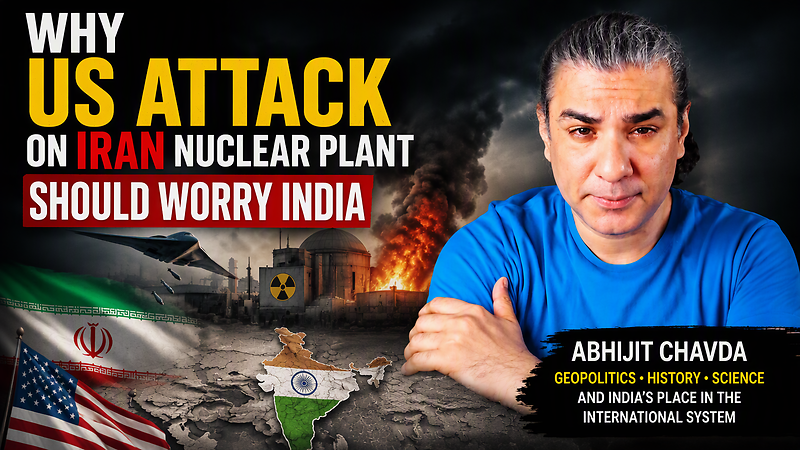
Abhijit Chavda, a popular YouTuber, argues that recent US military actions against Iran, specifically the strike on the Darkhovin nuclear construction site, pose significant risks not just for Iran but also for India. He emphasizes that such unilateral strikes violate national sovereignty and warns that India could be next if it does not bolster its military capabilities. Chavda claims, "Nothing is off-limits. Every red line can be crossed," suggesting that India must prepare to defend its interests against more powerful nations.
In another perspective, Chavda discusses the US bombing of India’s pier in Chabahar, asserting that this incident reflects India's precarious position under US influence. He notes that India complied with US demands to withdraw from Chabahar, only to have its investment bombed anyway. Chavda concludes that India's silence in this situation is a pragmatic choice, as outrage would yield little in terms of respect from the US.
Najam Sethi, another content creator, highlights India's diplomatic shortcomings with Iran. He points out that while India has sent lower-ranking officials to Iran, it has not engaged at a senior level, indicating a shift towards the US-Israel camp. He states, "India has indicated that our dealings with Iran are no longer what they used to be," underscoring a perceived decline in India-Iran relations.
In contrast, a contributor from the Khanversation channel asserts that India is reaffirming its strategic autonomy, emphasizing support for Iran and Palestine while condemning Israeli actions. They argue, "India has renewed support for Iran and expressed concern over attacks against Iran," positioning India as a mediator rather than a participant in a polarized conflict.
Another video from the same channel discusses India's outreach efforts, noting the appointment of a new ambassador to Iran as a sign of India’s intent to maintain dialogue with Tehran. This perspective stresses that India will not choose sides among its regional partners, aiming for a collaborative approach to security in the Middle East.
Global Politics with Dr. Qamar Cheema presents a more critical view of India's relationship with the US, arguing that while India is seen as a potential ally in the Iran conflict, it must navigate its complex ties carefully. Cheema notes, "US leaders increasingly view India as a possible solution in the Iran conflict," but cautions that India’s influence is limited due to its historical ties with Iran and the current geopolitical dynamics.
In summary, the debate around India's position amidst tensions involving Iran, Israel, and the US reveals a spectrum of opinions. While some argue for a clear stance and military readiness, others advocate for strategic autonomy and diplomatic engagement. The consensus appears to be that India must tread carefully to maintain its interests while balancing relationships in a volatile region.