Is SIR Undermining Democracy by Allowing the State to Choose Voters?
Nov 4, 2026, 17:39 IST
Summary
The debate over SIR reveals stark divisions on its impact on democracy in India. Yogendra Yadav argues it skews elections in favor of the BJP, while Sakshi Joshi raises concerns about voter disenfranchisement. Sanjay Dixit claims the Election Commission colludes with the BJP, and Ajit Anjum highlights constitutional risks, emphasizing the need for accountability.
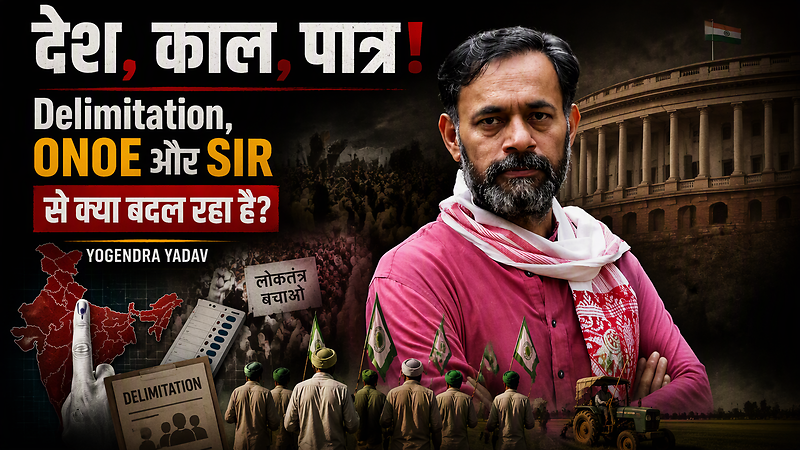
The debate surrounding the SIR (Systematic Voter Registration) raises critical questions about the integrity of India's democratic process. Prominent voices from various sectors are weighing in, highlighting the potential ramifications of allowing the government to influence voter eligibility.
Yogendra Yadav, a political analyst and activist, firmly argues that SIR, along with delimitation and the One Nation, One Election (ONOE) initiative, skews the electoral landscape in favor of the Bharatiya Janata Party (BJP). He states, 'the entire structure of electoral democracy is being distorted,' suggesting that the government is effectively choosing its voters by diminishing the political weight of regions that do not consistently support the BJP. Yadav warns that if delimitation is based on the 2027 census, it could severely reduce the representation of anti-BJP states.
In a similar vein, Yadav emphasizes in another video that 'democracy requires voters to choose governments, not governments to choose voters.' He argues that selective exclusions from voter rolls could escalate, transforming what is currently a manageable issue into a broader crisis of representation, potentially impacting 30 to 40 percent of the electorate.
Sakshi Joshi, a popular journalist, adds another layer to the discussion by questioning the practical implications of SIR. She raises concerns about the centralization of voter registration powers and the potential disenfranchisement of eligible voters, exemplified by a case in Goa where 97 eligible voters faced software barriers. Joshi emphasizes that if local election officials are restricted by IT systems, it raises serious questions about accountability and the integrity of the electoral process.
Contrasting with these concerns, Sanjay Dixit from The Jaipur Dialogues argues that the Election Commission is colluding with the BJP government, suggesting that the entire electoral system is compromised. He insists that the names of key officials involved will not be forgotten, implying a future reckoning for their actions.
Ajit Anjum, a political commentator, supports Yadav's stance, asserting that the alleged vote-fixing facilitated by SIR undermines democracy and erodes public trust in institutions. He warns that such practices could lead to a weakened constitutional framework.
The legal implications of SIR are also highlighted by Barkha Dutt, a renowned journalist, who discusses the disenfranchisement of 90 lakh voters in West Bengal. She notes that 22 lakh disenfranchised voters filed appeals, with 93% of resolved cases siding with the voters. Dutt's analysis underscores the gravity of the situation, suggesting that the government's actions are not just bureaucratic missteps but potentially illegal maneuvers to manipulate electoral outcomes.
Ajit Anjum further emphasizes that over 100 senior figures have expressed concerns about constitutional protections being threatened by SIR. He argues that the process itself is illegal, as evidenced by the Election Commission's own admissions regarding the legitimacy of its directives.
In conclusion, the debate over SIR reveals a stark divide in opinions on its implications for democracy in India. While some see it as a strategic move by the government to consolidate power, others warn of the systemic risks it poses to voter representation and electoral integrity. As these discussions unfold, the future of democratic practices in India hangs in the balance, demanding vigilant scrutiny from both the public and the judiciary.