Is the Election Commission Under Gyanesh Kumar's Arbitrary Control?
Oct 30, 2026, 19:00 IST
Summary
The debate over Chief Election Commissioner Gyanesh Kumar's control of the Election Commission intensifies, with accusations of arbitrary decision-making from various voices, including fellow commissioners and political leaders. Ajit Anjum highlights dissent from within the commission, while Akash Banerjee and others call for Kumar's resignation. Former bureaucrats demand cancellation of the ongoing voter revision process, raising concerns about democracy's integrity.
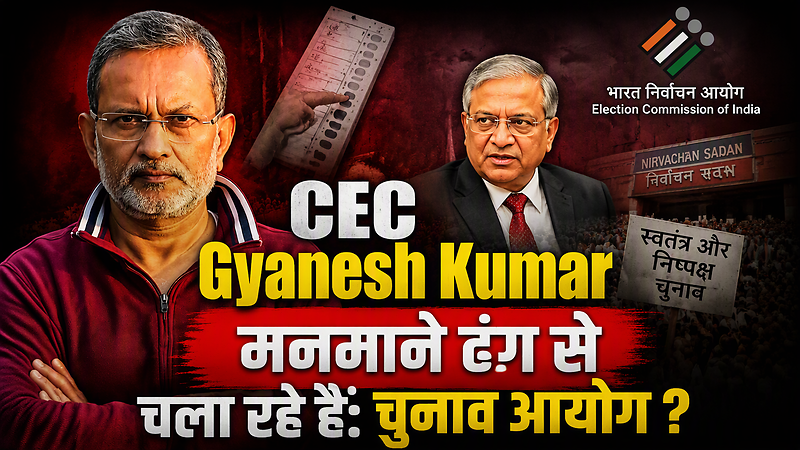
The debate over whether Chief Election Commissioner (CEC) Gyanesh Kumar is running the Election Commission of India arbitrarily has intensified, spurred by allegations from various quarters, including fellow election commissioners, political leaders, and former bureaucrats. Ajit Anjum, a prominent journalist, argues in his video that Kumar's unilateral decision-making style has turned the Election Commission into a personal fiefdom. He accuses Kumar of treating the commission as his 'inheritance' and making arbitrary decisions without proper consultation. Anjum highlights a significant report from the Indian Express, which claims that two election commissioners, Sukhbir Singh Sandhu and Vivek Joshi, have raised objections 14 times in ten months regarding the Special Intensive Revision (SIR) process, which has led to the deletion of millions of voter names across the country.
Echoing Anjum's sentiments, Akash Banerjee from the Deshbhakt channel expresses that if Kumar had any integrity, he would resign. He criticizes Kumar for sidelining other commissioners and making significant decisions without their input, which he labels as 'authoritarian'. Banerjee also references the Indian Express investigation, asserting that the commission's operations have become chaotic under Kumar's leadership, with decisions being made that violate legal norms.
On a similar note, Pragya Mishra from Ulta Chasma emphasizes that Kumar's claims of impartiality are contradicted by the dissenting voices within the commission itself. She points out that both Sandhu and Joshi have formally complained about Kumar's disregard for their advice, describing the situation as a blatant violation of democratic principles.
Further complicating the debate, Harsh Vardhan Tripathi calls for Kumar to publicly address the discrepancies highlighted by his fellow commissioners. He insists that transparency is vital for maintaining the integrity of the electoral process and suggests that the recent changes made by Kumar should be scrutinized closely.
Legal and constitutional concerns have also been raised by Saurabh Shukla, who argues that if the irregularities in the elections conducted in states like Bihar and West Bengal are proven, they should be annulled. He insists that Kumar's actions are likely being directed by higher authorities, hinting at a deeper political conspiracy.
The criticism has reached a political crescendo, with Yogendra Yadav stating that the commission is effectively operating under a dictatorship, driven by political backing. Yadav notes that significant procedural changes are occurring without due process or documentation, further eroding trust in the commission.
In a significant development, nearly 100 former bureaucrats have issued an open letter demanding the cancellation of the SIR process, claiming it has been marred by arbitrary deletions and the imposition of unreasonable requirements on voters. They warn that the ongoing mismanagement could jeopardize India's democratic framework.
Political figures have also joined the fray, with Congress President Mallikarjun Kharge and other leaders from the INDIA alliance demanding Kumar's resignation, alleging that his actions amount to an attack on democracy. They plan to organize rallies to protest against the commission's handling of electoral processes.
As the debate rages on, Kumar's supporters argue that the commission's recent adjustments to voter registration requirements, particularly the removal of controversial queries from Form 6, indicate a responsiveness to public concerns. However, the overwhelming consensus among critics is that the commission's integrity is in jeopardy under Gyanesh Kumar's leadership, marking a pivotal moment in India's electoral governance.