Is the Mecca Joint Defence Agreement Aimed at India?
Oct 14, 2026, 20:30 IST
Summary
The Mecca Joint Defence Agreement has ignited debate over its implications for India. Lt Gen P R Shankar asserts it's aimed at West Asia, while Khanversation suggests it won't harm India's interests. Dr. Qamar Cheema warns about potential trade risks for India. The discussion reflects differing views on the agreement's significance and its geopolitical consequences.
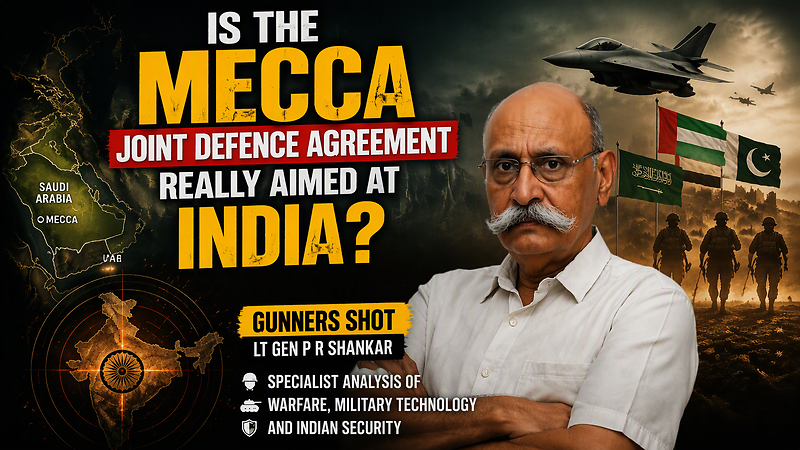
The Mecca Joint Defence Agreement has sparked a heated debate, particularly regarding its implications for India. Lt Gen P R Shankar, a military expert featured on the channel gunners shot, argues that the agreement primarily targets West Asia and is not aimed at India. He asserts, "This agreement is fundamentally directed at West Asia. There is nothing against India," while noting that from a Pakistani perspective, it may seem otherwise. He highlights that the United States is behind the agreement, stating, "The U.S. is very happy with the emergence of this agreement," as it shifts regional defense responsibilities away from American oversight, particularly concerning Iran.
In contrast, Khanversation's original channel has a more nuanced view. In a segment titled 'What the Mecca Joint Defense Agreement Means,' host Mukhtar Khan discusses the collective defense implications of the agreement, emphasizing that any attack on one member—Saudi Arabia, Turkey, or Pakistan—will be seen as an attack on all. This sentiment is echoed in another video where Khan argues that while the agreement is significant, it won't adversely affect India's interests. He notes, "This development is important, but it won't harm India's interests."
However, other voices in the debate suggest a more cautious approach. Dr. Qamar Cheema, who appears on the Global Politics channel, expresses skepticism about the agreement's effectiveness in a segment titled 'Will the Makkah Accord be a game changer in the Middle East?'. He states, "The pact may not significantly change the Middle East," emphasizing that without a grand reconciliation between Iran and the U.S., the pact’s impact will be limited.
Cheema further explores the potential risks for India, indicating that if the agreement proves credible, it could complicate India's strategic calculations. He warns, "If Saudi Arabia were to halt trade with India, it could pose serious risks for employment and economic stability in India."
Meanwhile, other creators, such as Gaurav Arya from The Chanakya Dialogues, emphasize the U.S.'s involvement, stating, "This entire agreement is happening with American blessings." He suggests that the choice of Mecca for the signing was intentional for its political messaging within the Islamic world.
Adding another layer to the discussion, Cheema addresses the fears surrounding Iran's role in the region. He states, "This agreement seeks collective deterrence without targeting a specific third party," hinting that while Iran is a concern, the agreement is framed defensively. He posits that hostile actors may attempt to provoke Saudi Arabia into a broader conflict, complicating Pakistan's role in the region.
The perspectives converge on the notion that while the Mecca Joint Defence Agreement is significant, its implications for India are complex. Some view it as a regional security measure against Iran, while others caution against overestimating its potential to alter the geopolitical landscape dramatically. The debate remains charged, with varying interpretations of the agreement's intent and consequences for India and the broader region.