Is the Quad Partnership a Trusted Alliance or an Anti-China Bloc?
Nov 24, 2026, 10:00 IST
Summary
The debate over the Quad partnership's purpose is heating up. Major Madhan Kumar argues it serves as an anti-China military alliance, while Barkha Dutt sees it as a constructive and trusted partnership focused on regional stability. Their contrasting views highlight the complexities of international relations in the Indo-Pacific and the Quad's evolving role.
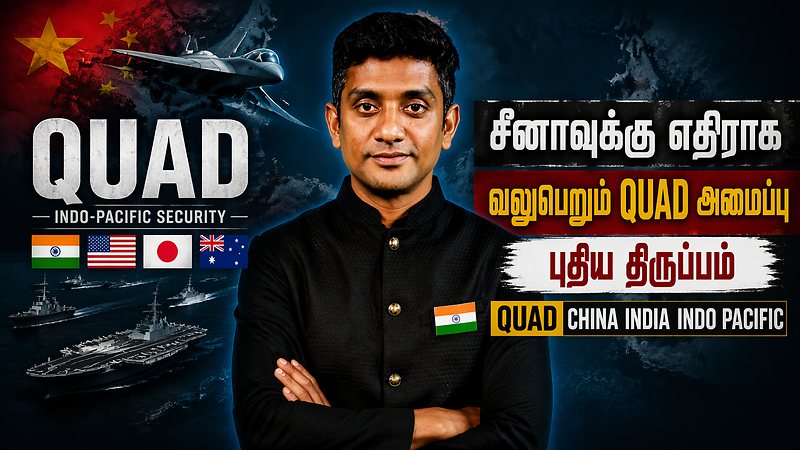
The Quad partnership, involving the United States, India, Japan, and Australia, has sparked intense debate about its true nature. Major Madhan Kumar, a popular YouTuber, argues that the Quad is primarily an anti-China alliance. He states that 'QUAD is strengthening cooperation to counter China in the Indo-Pacific,' highlighting discussions around 'anti-submarine and anti-surface warfare capabilities.' Kumar emphasizes that interoperability among member nations is essential for maintaining a 'free, open Indo-Pacific.'
In contrast, Barkha Dutt, a prominent journalist and popular YouTuber, presents a more optimistic view of the Quad. She argues that for India, the Quad represents 'a constructive, trusted partnership.' Dutt points out that this cooperation extends beyond military matters to include 'maritime security and reliable supply chains,' and focuses on 'new technologies and disaster response.' Her perspective suggests that the Quad's purpose is multifaceted and not solely focused on countering China.
The disagreement between these two voices illustrates a broader debate within the international community. While Kumar frames the Quad as a military alliance specifically aimed at countering Chinese influence, Dutt advocates for a view that sees it as a collaborative effort to enhance regional stability and security.
Both creators highlight the importance of security in the Indo-Pacific region, but they diverge significantly in their interpretations of the Quad's ultimate goals. Kumar's focus on military capabilities suggests a confrontational approach, whereas Dutt's emphasis on partnership and cooperation indicates a desire for constructive engagement. This divergence raises critical questions about the future of the Quad and its role in international relations.
As the Quad continues to evolve, it remains essential to consider these differing perspectives to understand its implications fully. The alliance's actions and decisions will likely reflect a blend of these viewpoints, navigating the complex geopolitical landscape shaped by China's rising influence.