Jammers and Internet Cuts at Jantar Mantar: Security Measures or Suppression?
Oct 15, 2026, 20:41 IST
Summary
The debate around Jantar Mantar's security measures has intensified, with influencers like Abhisar Sharma criticizing the government's tactics as suppression, while journalists like Ajit Anjum highlight changes in police presence. Faye D'Souza condemns the use of jammers and heavy surveillance, questioning the implications for democracy. Perspectives converge on concerns about civil liberties amid extensive government control.
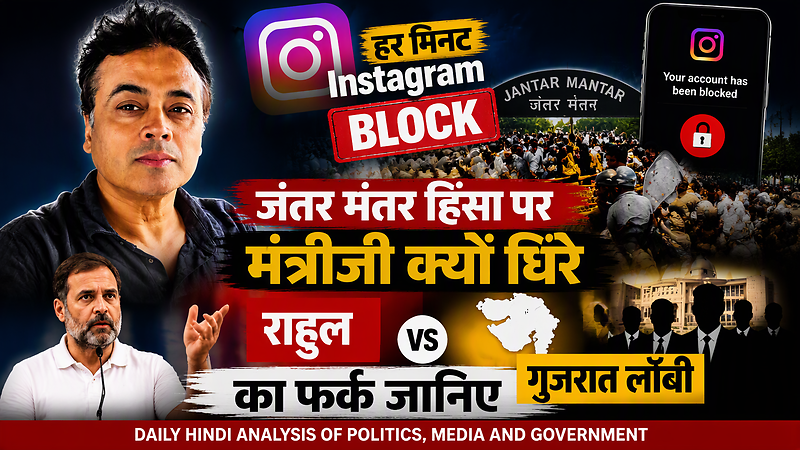
The situation at Jantar Mantar has ignited a fierce debate surrounding the balance between security and suppression of dissent. Influencer Abhisar Sharma highlights the Indian government’s alleged tactics to suppress protest voices by stating that, "from March through July, the BJP government reportedly blocked Instagram accounts every minute." He criticizes Minister Kiren Rijiju's claims that no serious injuries occurred during the protests, asserting that they are misleading. He recounts meeting a protester with pellet wounds, questioning Rijiju's confidence in denying harm to demonstrators.
Conversely, Ajit Anjum, a journalist, notes the recent removal of barricades and metal detectors at Jantar Mantar, suggesting a shift towards more open access for protesters. He observes that previously, "around fifty police officers checked each person before allowing entry," indicating a significant change in the police's approach. However, he also points out the extensive surveillance in place, with over 60 CCTV cameras monitoring the area, reinforcing the atmosphere of control.
The debate intensifies with Faye D'Souza, a prominent journalist, who condemns the heavy police presence and the deployment of jammers, which she claims turned Jantar Mantar into a "war zone." She argues, "If so much effort is put into preventing protests, why not focus on issues like the recent paper leaks that have led to student suicides?" D'Souza expresses frustration over the closure of metro stations and the spread of protests across various Indian cities, further emphasizing the government's heavy-handed tactics.
D'Souza also points to Congress MP Priyanka Gandhi Vadra's remarks on the government’s actions, questioning, "What kind of democracy is this?" She highlights the government’s failure to allow young protesters to communicate with their families, alleging that police have used tear gas and force against demonstrators. This sentiment resonates with Abhijit Dipke, who describes the police's actions as an orchestrated effort to intimidate peaceful protesters. He asserts, "This is not a symptom of democracy; it is tyranny," criticizing the police for checking every protester’s belongings while allowing trucks filled with stones to gather nearby.
In a more tactical observation, Arfa Khanum Sherwani reports on the police's announcement of a 7 pm ultimatum for protesters to vacate the area, leading many to leave. This ultimatum adds a layer of urgency to the already tense situation. Meanwhile, Sanjay Rajoura questions the government’s disproportionate response, stating that if the authorities can mobilize such extensive security for peaceful protests, they should be equally capable of addressing security threats in more vulnerable regions.
As the debate unfolds, the perspectives converge on a shared concern: the extent of government control over protests and the implications for democracy. The differing views illustrate a complex landscape where security measures are weighed against the fundamental right to protest, prompting a critical examination of how such measures are enacted and their broader implications for civil liberties in India.