Merit vs Representation: The Grievances of the General Category
Oct 8, 2026, 18:52 IST
Summary
The debate over merit versus representation features distinct voices. Ajeet Bharti emphasizes the need for opportunities for disadvantaged groups without undermining successful individuals. Sandeep Deo criticizes reservation policies for deepening caste divisions. Sanjay Rajoura challenges claims of job theft by reserved categories, while Barkha Dutt highlights the flawed merit system that fuels resentment among excluded students.
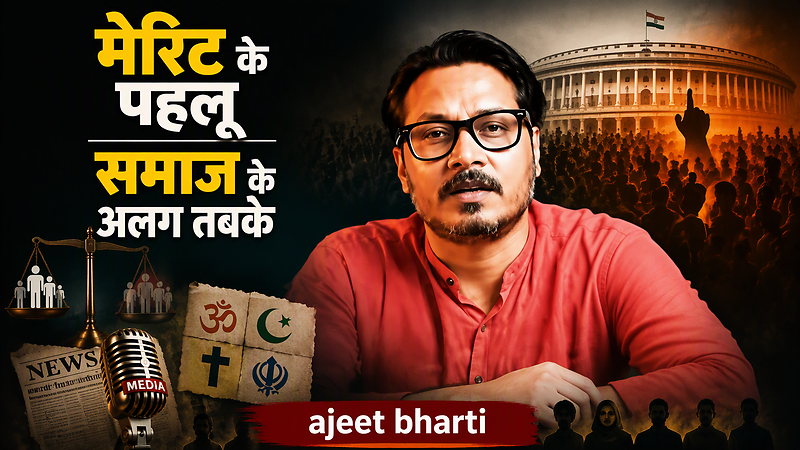
The debate over merit versus representation in India has sparked significant contention among various voices. Ajeet Bharti, a YouTuber, argues that merit is a social construct that exists in various sectors, including agriculture and education. He contends that while some groups, like the Koeri farmers, outperform larger farming communities, it is crucial to provide opportunities to disadvantaged groups without undermining the abilities of those who have succeeded. He states, "Disadvantaged groups deserve opportunities without denying successful groups’ abilities."
On the other hand, Sandeep Deo, a popular YouTuber from India Speak Daily, takes a critical stance against reservation policies. In his video, he claims that the current government, particularly under Narendra Modi, has exacerbated caste divisions and created a hostile environment for general-category individuals. He asserts, "The BJP government deepened caste divisions and hostility through reservation politics," pointing to historical opposition from the Congress party towards reservation.
In another video, Sandeep Deo emphasizes the implications of the SC/ST Atrocities Act, arguing that it criminalizes individuals from the general category. He claims that "general-caste students may face SC/ST accusations upon entering college," suggesting that this law unfairly targets them and has worsened their situation.
Contrasting these views, Sanjay Rajoura, known as The Fourth Dimension, challenges the notion that reserved categories are taking jobs from general-category individuals. He argues, "Opponents should show data that SC, ST, and OBC people took jobs," pointing out that professions like journalism and law are still dominated by upper-caste individuals. He highlights the pervasive nature of casteism in Indian society, asserting that it is deeply embedded and cannot simply be wished away by eliminating reservations.
Barkha Dutt, a prominent journalist and YouTuber, presents a nuanced perspective on the issue. In her discussion about reservations, she acknowledges that while merit is not absent in any group, the system is flawed. She notes, "If 93% scorers lose seats to 70% candidates, excluded students feel angry," emphasizing that the competition for limited seats in prestigious institutions fuels resentment among those who feel left out.
Sandeep Deo, again from India Speak Daily, expands on the historical context of reservation policies, claiming that the introduction of quotas by the Vajpayee government and subsequent amendments have compromised merit. He asserts that these changes have led to situations where a less qualified individual could be promoted over a more qualified general-category individual simply due to their caste status.
The perspectives illustrate a complex web of grievances where the general category feels sidelined by policies intended to uplift historically marginalized groups. While Ajeet Bharti advocates for recognizing merit across all sectors, Sandeep Deo and others express concern over how reservation policies might undermine meritocracy, creating a contentious dialogue around the future of equality in India.