Mohan Bhagwat's Remarks: Genuine Outreach or Old RSS Playbook?
Nov 26, 2026, 00:20 IST
Summary
Mohan Bhagwat's remarks on Hindu-Muslim unity have sparked a debate over their sincerity. Abhisar Sharma argues they signal a shift from BJP rhetoric, while Barkha Dutt critiques them as an old RSS tactic. Kumkum Binwal questions the contradictions in Bhagwat's stance, and Ajit Anjum suggests power dynamics underpin the discourse, reflecting a complex political landscape.
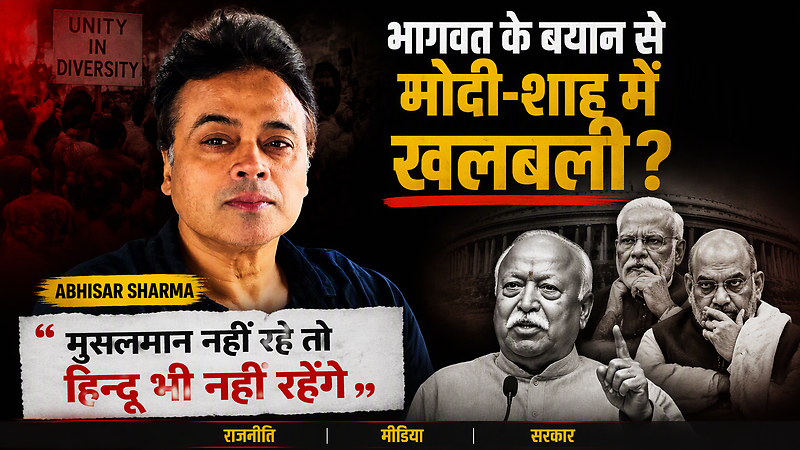
The recent remarks by Mohan Bhagwat, the chief of the Rashtriya Swayamsevak Sangh (RSS), regarding Hindu-Muslim unity have ignited a heated debate. While Bhagwat asserts that Hindu identity loses significance without Muslims in India, critics argue that these statements are merely a rehash of old RSS ideologies.
Abhisar Sharma, a journalist, emphasizes that Bhagwat's statement, which suggests that if Muslims are removed from India, Hindus too will lose their identity, is a significant departure from the usual rhetoric of the ruling Bharatiya Janata Party (BJP). He argues, "Hindu identity has no meaning without Muslims remaining in India," highlighting that Bhagwat's comments serve as a pointed critique directed at Prime Minister Narendra Modi and Home Minister Amit Shah. Sharma perceives Bhagwat's outreach as an urgent call for the BJP to reconsider its divisive tactics, particularly in the context of Gujarat's political landscape.
On the contrary, Barkha Dutt, a prominent journalist, labels Bhagwat's remarks as an "old trick in the RSS' playbook." She contends that the RSS has never fully repudiated the ideologies of its past leaders, who have historically viewed Muslims and Christians as internal threats to India. Dutt cites writings from influential RSS figures that depict a long-standing disdain for the notion of Hindu-Muslim unity, suggesting that Bhagwat's recent comments are more about maintaining a facade than fostering genuine inclusivity.
In a similar vein, another video from Dutt reinforces this skepticism. She argues that Bhagwat's statements are intended for an external audience, projecting an image of unity while the underlying ideological message remains aimed at RSS members. She recalls historical instances where RSS leaders, like Golwalkar, have explicitly described Muslims as threats, casting doubt on the sincerity of Bhagwat's outreach.
Kumkum Binwal, another commentator, critiques Bhagwat's contradictory stance, pointing out that while he speaks of inclusion abroad, the reality within India reflects a different narrative. Binwal highlights the demographic realities of India, noting that a call for an "Akhand Bharat" (undivided India) would significantly increase the Muslim population, raising questions about the feasibility of such ideals. She warns that taking the RSS’s ideological elders seriously could lead to detrimental consequences for the country.
Ajit Anjum, a media personality, shifts the focus from ideology to power dynamics, suggesting that the rise and fall of political power are inevitable. He notes that those who believe they can control the narrative through arrogance will eventually face reality. This perspective underscores a broader skepticism about the political motivations behind Bhagwat's remarks, viewing them as attempts to navigate a complex political landscape rather than a genuine call for unity.
As the debate unfolds, it is clear that Bhagwat's statements have sparked diverse reactions. Some see them as a sincere attempt to bridge communal divides, while others interpret them as a strategic maneuver to mask the RSS's historical positions. The discourse around these remarks reveals deep-seated tensions and varying interpretations of Hindu-Muslim relations in contemporary India.