Can India Balance BRICS and the Quad Without Losing Its Edge?
Nov 5, 2026, 00:30 IST
Summary
The debate over India's ability to balance its roles in BRICS and the Quad intensifies. Ashok Malik emphasizes rational foreign policy based on national interests, while another voice argues that India's military collaborations with Western allies do not contradict its BRICS leadership. Amitabh Kant insists on the necessity of working with the U.S. to achieve prosperity, cautioning against an anti-Western stance within BRICS.
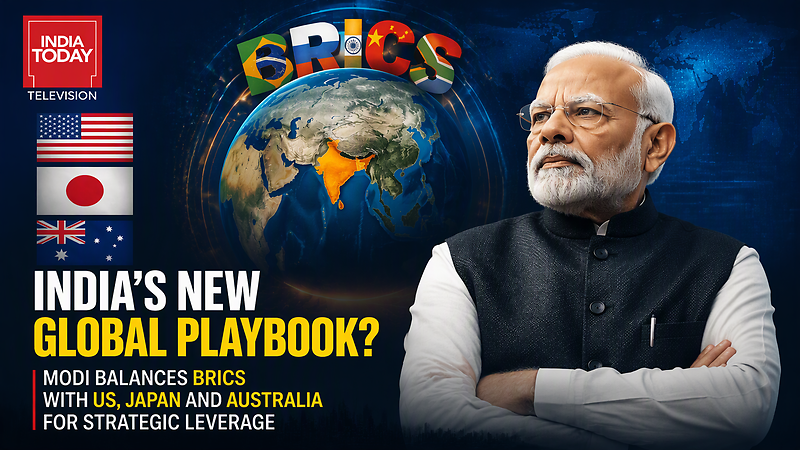
As India navigates its role in global geopolitics, the debate intensifies over whether it can effectively balance its commitments to BRICS and the Quad. Popular Youtuber Ashok Malik posits that India’s foreign policy has historically been driven by national interests rather than external influences, stating, "We are taking very rational and logical positions based on our national interest." He highlights India's participation in both BRICS and the Quad as essential, emphasizing, "We cannot choose. We have to work with both sides." This sentiment echoes throughout the discourse.
In contrast, another content creator from India Today argues that India's involvement in military exercises with the United States, Japan, and Australia does not conflict with its leadership in BRICS. This creator maintains that India is not sending mixed signals but rather multiple signals, stating, "India sends multiple signals, and that is the essence of the strategy." This perspective suggests that India is crafting a unique diplomatic identity that allows it to engage with both Western and non-Western powers.
Yet, the relationship with Russia complicates matters. One participant notes, "When we import Russian oil, what does the U.S. do? It imposes sanctions or threatens tariffs." This tension indicates that while India may aim for a balanced approach, external pressures, particularly from the U.S., could challenge its ability to do so. The creator emphasizes that the U.S. still holds significant influence, referring to Donald Trump as "the elephant in the room," illustrating the unpredictability of American policy.
Amitabh Kant, another prominent figure in the discussion, underscores the importance of maintaining a collaborative stance, stating, "It is in India’s national interest to work with the United States." He argues that no nation has achieved prosperity without engaging with the U.S., citing Japan and China as examples. Kant insists that India should anchor its position within BRICS while also fostering relationships with the West to achieve its economic goals.
However, the fear of an anti-Western stance within BRICS persists. Kant asserts that it is crucial for BRICS not to adopt an adversarial position against the West. This aligns with the earlier claim that India should avoid being perceived as a part of an anti-Western bloc, thereby ensuring it can leverage relationships on both fronts.
The perspectives diverge on whether India can truly maintain this balance. While some argue that India’s strategic maneuvering allows it to thrive in both spheres, others warn of the potential repercussions of U.S. sanctions and tariffs. The consensus, however, seems to be that India must continue to engage with both BRICS and the Quad, navigating a complex geopolitical landscape that demands careful diplomacy and foresight. As this debate unfolds, the world watches closely to see how India will chart its course in a rapidly changing global order.