Navigating Alliances: India's Dilemma Between China and the US
Nov 2, 2026, 11:30 IST
Summary
The debate over India's alignment between China and the US reveals contrasting perspectives. Khanversation argues for India as a 'third partner' in global alliances, while Dr. Qamar Cheema highlights India's warming relations with China. Lieutenant General P.R. Shankar points to tensions in US-India ties, and Abhijit Chavda defends India's status as a rising major power, emphasizing strategic autonomy.
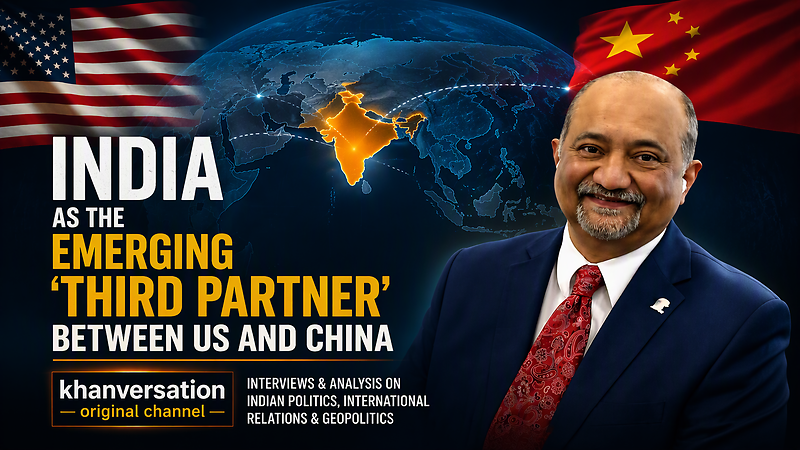
As India contemplates its position between the competing influences of China and the United States, a diverse array of voices emerges in the debate. Popular YouTuber Khanversation argues that India is well-placed to become a 'third partner' in global alliances, noting that countries like Japan, Canada, and the UK are seeking a balance that does not hinge solely on either superpower. He emphasizes, "India currently has the strongest opportunity to become the third partner, as it is less domineering than China and less arrogant than America."
In contrast, Dr. Qamar Cheema, a political commentator, highlights the normalization of India-China relations as a significant outcome of recent diplomatic engagements. He suggests that India is sending a clear message to the West by urging restraint in the US-Iran conflict and opposing the weaponization of critical minerals, which he sees as a direct challenge to American influence. "Washington is more careful because it knows that its investment in India over the past 20 years may be undermined by a warming relationship between India and China," he asserts.
Cheema elaborates further in another video, positing that India and China have aligned against potential US sanctions on Russian oil buyers, indicating a strategic partnership that complicates India's relationship with Washington. He notes, "This is something very significant; India and China are now presenting a united front against America."
Khanversation takes a different approach, arguing that India should stop relying on American support and instead represent the concerns of the Global South. He states, "America has been central to India’s foreign-policy development strategy for twenty years, but this dependence reflects a panic over China’s rise."
On the military front, Cheema questions India's potential acquisition of Russian Su-57 jets over American F-35s, citing America's refusal to provide crucial components as a significant disadvantage. He suggests that India is aware of its strategic needs and may prioritize relationships that best serve its national interests.
In the context of India-US relations, Lieutenant General P.R. Shankar outlines six critical break points, including trade deals and immigration policies, suggesting that these issues could lead to a significant shift in India's alignment. He observes, "India has come to a point where it says no more; we have drawn a line in the sand regarding our ties with the US."
Adding to this complexity, Cheema argues that the Trump administration is frustrated with India's improving relations with China, noting that there have been significant declines in H-1B visa approvals for Indians, which could further strain bilateral ties. He states, "The relationship between Indians and Americans is going to become problematic if these trends continue."
Abhijit Chavda, another commentator, disputes the notion that India should be classified as a middle power, asserting that India is a rising major power that makes independent strategic decisions. He critiques the dependency of countries like the UK and Canada on American protection, arguing that India's sovereignty is essential for its global standing.
Ultimately, the debate underscores India's precarious position as it seeks to navigate its alliances amidst global pressures. While some voices advocate for a stronger alignment with the US, others call for an independent stance that prioritizes India's own strategic interests in a multipolar world.