'Papa stopped the war': Did the Iran war expose India's diplomacy?
Nov 3, 2026, 19:00 IST
Summary
The debate over India's diplomacy during the Iran war features contrasting views. Ashok Kumar Pandey argues Modi's pro-Israel stance has left India vulnerable, while Arfa Khanum Sherwani critiques India's lack of influence in peace efforts. Dr. Qamar Cheema suggests U.S. perceptions of India as a potential ally are complicated by the limitations of its influence in Iran.
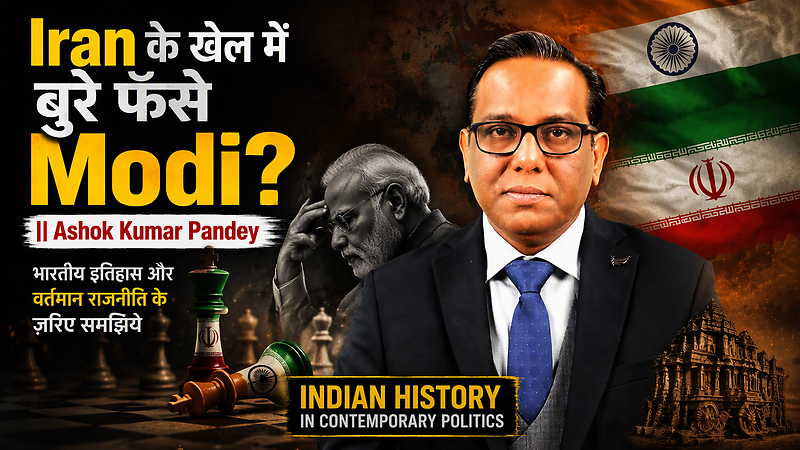
The ongoing debate about India's diplomatic stance amid the Iran war reveals contrasting perspectives from various content creators. Ashok Kumar Pandey, a popular YouTuber, argues that India's Prime Minister Narendra Modi has been ensnared in a diplomatic trap by Iran. In his video, he suggests that Iran's invitation to Modi to attend Ayatollah Ali Khamenei's funeral is a strategic move to pressure India into reaffirming its friendship with Iran, especially after Modi's support for Israel, which has now become a liability. Pandey claims, "Iran's invitation pressures Modi to prove friendship and preserve Iranian oil access." He highlights the irony that while Modi has aligned India with Israel, it has left India in a precarious position as Israel's military efforts falter.
In a related video, Pandey expands on this theme, suggesting that Netanyahu had assured both Modi and Trump that the Iran war would be a short engagement, implying that India misjudged its diplomatic footing. He notes, "India's foreign secretary visited Iran only after regime-change expectations failed," indicating a reactive rather than proactive foreign policy.
Contrastingly, Arfa Khanum Sherwani, another prominent YouTuber, critiques Modi's role in the diplomatic landscape. She points out that despite Modi's claims of India being a 'world leader', the country failed to mediate effectively in the Iran conflict. She states, "If we were truly a world guru, we would have played a significant role in stopping the war." Sherwani emphasizes that Pakistan has taken center stage in peace efforts, while India remains sidelined, thus questioning Modi's narrative of India's global influence.
Adding another layer to the discussion, Dr. Qamar Cheema argues that the U.S. views India as a potential ally in resolving the Iran conflict. He posits that the U.S. sees India's consumer market as a leverage point against Iran, but he warns that India's influence may not be sufficient to sway Iranian leadership. He states, "India's consumer-market influence cannot easily compel Iran's leadership to comply," indicating skepticism about India's ability to navigate complex geopolitical landscapes.
Cheema also notes the implications of U.S. politics on India's foreign relations, suggesting that a shift in American leadership could redefine how India is perceived in the context of the Iran war. He mentions, "Democrats need to look more at India from the American strategic community's lens," highlighting the importance of U.S.-India relations in the ongoing conflict.
Overall, while Pandey emphasizes the pitfalls of Modi's pro-Israel stance and its repercussions for India’s relationship with Iran, Sherwani argues for a more assertive Indian role in global diplomacy, contrasting with Cheema's view on the limitations of India's influence. This debate underscores the complexities of India's diplomatic positioning in the face of shifting geopolitical alliances and conflicts.