Protests for Gyanesh Kumar's Resignation: A Call for Democracy or Disruption?
Nov 1, 2026, 23:26 IST
Summary
Protests at Jantar Mantar against Chief Election Commissioner Gyanesh Kumar spark a debate on whether they pressure the government or disrupt order. Activists like Yogendra Yadav argue for reclaiming democracy, while others, including Ajit Anjum, highlight government repression. Some critics question the protests' legitimacy, advocating for due process. The movement reflects a pivotal moment in Indian politics.
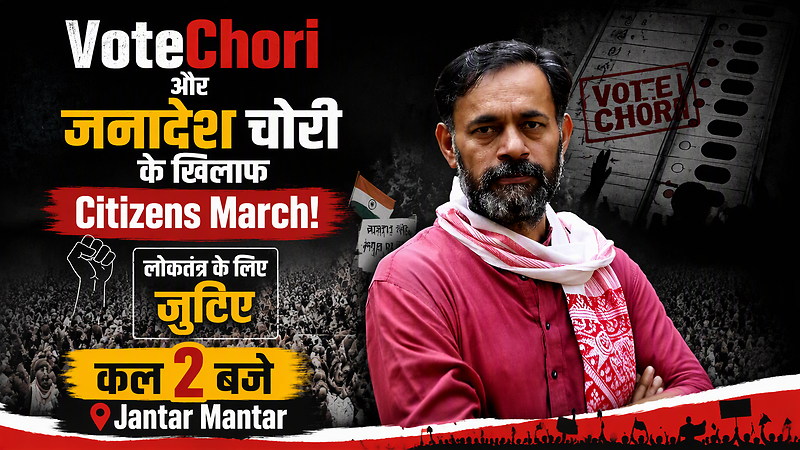
In recent protests at Jantar Mantar, voices from across the political spectrum have united against Chief Election Commissioner Gyanesh Kumar, igniting a debate over whether these demonstrations serve as a necessary pressure on the government or merely disrupt public order. Prominent figures like Yogendra Yadav, a political activist, assert that the Election Commission has become a 'mockery' and calls for citizens to rally for a Citizens March to reclaim democratic rights, emphasizing that 'we will not stop until conditions change.'
Contrastingly, Ajit Anjum, a journalist, highlights the heavy-handed response from authorities, stating that the Delhi Police's deployment of CRPF and BSF reflects a blatant attempt to suppress peaceful protests. He describes the protest site as transformed into 'Gyanesh Chowk,' where demonstrators are required to seek permission to assemble, a point echoed by others who argue that the government's tactics are suppressing democratic rights.
Yadav and Anjum's perspectives converge on the notion that the protests are a response to perceived injustices, with Yadav declaring, 'If the parliament does not allow impeachment, the people will take to the streets.' This sentiment resonates with many protesters who feel their voting rights are under threat, as articulated by various activists who have raised concerns about the SIR (State Identification Report) that allegedly disenfranchises over 13 crore voters.
Several creators, including Faye D'Souza, emphasize the urgency of the situation, stating that the government's actions have forced citizens into a corner where they must defend their democratic rights. D'Souza reports on the usage of water cannons against Congress protesters and calls attention to the widespread frustration among citizens who feel their voices are being ignored.
In a more combative tone, Mamata Banerjee, a prominent political leader, has demanded Kumar's immediate resignation, labeling him a 'thief' who has compromised the electoral integrity. She warns that if action is not taken against Kumar, the agitation will escalate beyond control.
However, some voices challenge the legitimacy of the protests. The Sham Sharma Show questions the rationale behind the demonstrations, arguing that without a formal ruling from the Supreme Court confirming vote theft, the protests lack foundation. This perspective suggests that due process should precede any calls for resignation, echoing sentiments about the importance of legal protocols in a democratic society.
As the protests continue, various creators stress the need for a unified front. Activist Prakash Raj asserts, 'Every street is Jantar Mantar,' urging citizens to join the movement against perceived electoral fraud. Meanwhile, Yogendra Yadav notes that despite police repression, the spirit of the protests remains strong, with young activists leading the charge. He insists that this is not merely a momentary uprising but a significant movement aimed at reclaiming democracy and electoral integrity.
In this complex landscape, the debate surrounding the protests against Gyanesh Kumar illustrates a critical juncture in Indian politics, with fervent calls for change juxtaposed against arguments for legal adherence and public order. As the situation unfolds, the resilience of the protesters and the government's response will be pivotal in shaping the future of democratic engagement in India.