Rahul Gandhi's Political Shift: Decency vs. Confrontation and BJP's Calculated Advantage
Oct 30, 2026, 23:30 IST
Summary
The debate around Rahul Gandhi's political strategy reveals contrasting views. NDTV argues the BJP benefits from Congress's revival, suggesting Gandhi's protests are easier to counter. The Quint praises Gandhi's commitment to decency, maintaining a stable voter base. India Today notes a shift to confrontation post-Bharat Jodo Yatra, while BJP's Smriti Irani criticizes Gandhi's tactics as undermining democracy.
As Rahul Gandhi navigates his evolving political landscape, opinions diverge sharply on whether his approach—marked by decency or confrontation—benefits the Indian National Congress or inadvertently strengthens the Bharatiya Janata Party (BJP).
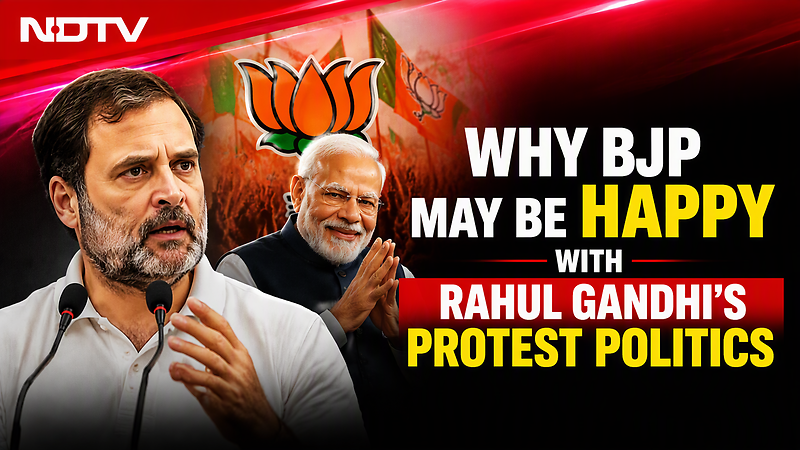
According to NDTV, in their analysis titled *Why BJP May Be Happy With Rahul Gandhi's Protest Politics*, the BJP may actually welcome Congress's revival. The argument posits that while there is a growing discontent with Narendra Modi's government, it is essential for the opposition to offer tangible solutions rather than merely voicing grievances. The piece suggests that Gandhi's protests are easier for the BJP to counter than regional challengers, indicating a strategic advantage for the ruling party amidst Congress's struggles.
Contrastingly, The Quint emphasizes Gandhi's commitment to decency in a political climate rife with hate. They argue that despite being mocked and labeled a loser, Gandhi has maintained a respectful discourse, which has helped Congress sustain a 20% vote share nationally. This perspective suggests that Gandhi's approach, rooted in civility, offers a counter-narrative to the increasing vitriol in politics, potentially appealing to voters seeking a more constructive alternative.
In a shorter segment from India Today, experts note a significant shift in Gandhi's political brand following the *Bharat Jodo Yatra*. They argue that his earlier focus on love and reconciliation has given way to a more confrontational stance as he seeks to capitalize on Congress's recent electoral gains. This evolution indicates a strategic pivot towards more aggressive tactics in the lead-up to the 2024 elections.
Further insights from NDTV highlight the internal challenges facing Congress. The discussion around Gandhi and Priyanka Gandhi's protest tactics raises questions about opposition leadership effectiveness, indicating that while Gandhi attempts to galvanize support, there are lingering doubts about the party's direction and unity.
Moreover, another NDTV report delves into Gandhi's new political playbook, revealing that after previous electoral failures, there is a renewed urgency within Congress to innovate. This includes a focus on grassroots engagement, although it remains to be seen whether these strategies will yield the desired results.
On the other hand, BJP member Smriti Irani critiques Gandhi’s political maneuvering, suggesting that his call for regime change reflects a dangerous disregard for democratic processes. Irani argues that Gandhi's actions, including seeking external support to challenge the Modi government, highlight a fundamental misunderstanding of governance in a democracy, where elected officials cannot be overthrown through mob rule. This perspective underscores a stark disagreement with Gandhi's approach and positions the BJP as a defender of democratic norms.
As the debate unfolds, the question remains: does Gandhi's shift towards a more confrontational approach signal a genuine challenge to Modi's leadership, or does it play into the BJP's hands, allowing them to frame the narrative around a familiar opponent? With the 2024 elections looming, the dynamics of this political chess match will be crucial in determining the future of Indian politics.