SIR Controversy: Bogus Entries Purged or Genuine Voters Lost?
Nov 2, 2026, 11:09 IST
Summary
The SIR process in India has led to the deletion of millions of voters, prompting a fierce debate over whether these removals are justified or constitute systematic disenfranchisement. Yogendra Yadav warns of massive deletions, while Barkha Dutt and Ajit Anjum highlight the disproportionate impact on marginalized communities, particularly Muslims. Rahul Gandhi's engagement with affected voters underscores the urgency of the issue.
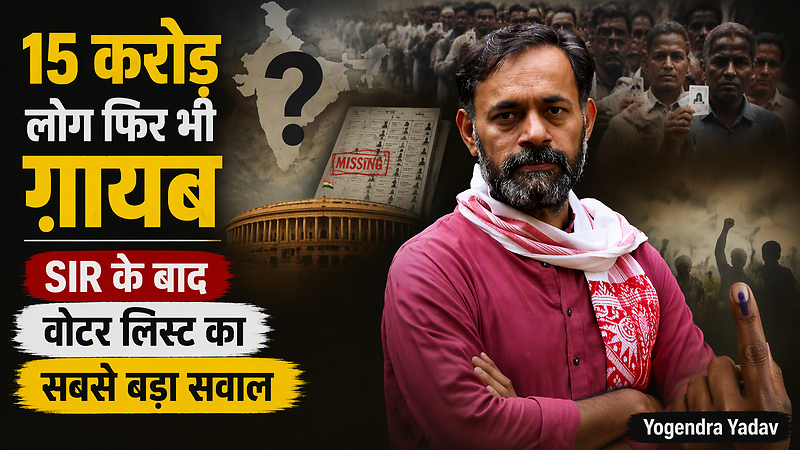
The recent Special Intensive Revision (SIR) of electoral rolls in India has ignited a heated debate over the legitimacy of voter deletions, with prominent voices offering contrasting views. Yogendra Yadav, a political analyst and activist, presents a dire warning, stating that the SIR could result in the removal of at least 11 crore names from the voter rolls, claiming that, 'After SIR, rolls may retain 88 crore against 103 crore eligible adults.' This raises serious concerns about the disenfranchisement of millions, which Yadav emphasizes as a significant issue that the Election Commission must address.
Further amplifying these concerns, Yadav's analysis in a separate video highlights the situation in Delhi, where he reveals that one-third of voters were deleted during the SIR process. He asserts that, 'The whole game seems to have a scam,' as 47 lakh voters were marked absent, shifted, or dead, with the Voter Rights Forum finding that at least one-third of these deletions were erroneous. This sentiment is echoed in his discussion on Haryana, where he notes that 33.8 lakh voters were removed, with an additional 45 lakh receiving notices questioning their eligibility.
The issue of erroneous deletions extends to specific regions, as seen in a video by Saurabh Shukla, who reports on a polling booth in Chandni Chowk where the number of voters plummeted from 927 to 729, with 728 marked as removed. Residents, primarily those who had previously supported the BJP, fear that their democratic rights are being systematically stripped away.
Barkha Dutt, a prominent journalist, raises the alarm about the staggering figure of 130 million names deleted from electoral rolls, questioning the Election Commission's accountability to the voters rather than political parties. She argues that the disenfranchisement process is arbitrary and unjustifiable, asserting, 'Mass disenfranchisement of Indian citizens would violate Articles 326 and 14 of the Constitution.'
Amidst these claims, Ajit Anjum, a journalist, highlights a troubling pattern of targeting specific demographics, noting that deletions disproportionately affect Muslim voters, with reports indicating that over 40% of those removed belong to this group. He cites the use of Form 7 objections as a tool for systematically removing these voters, raising concerns about the integrity of the electoral process.
In Goa, Pragya Mishra discusses the deletion of 97 voters who were initially cleared by election officials but were inexplicably omitted from the final list, highlighting systemic issues within the Election Commission. This situation is compounded by allegations of corruption, as Gyanesh Kumar, the Chief Election Commissioner, faces scrutiny for his role in these deletions, with calls for his resignation growing louder.
The public's response has been palpable, with Rahul Gandhi, a leading opposition figure, visiting affected areas to engage with voters who have lost their electoral rights. He asserts that these deletions are part of a larger scheme to undermine democracy, stating, 'The poor are being stripped of their voting rights.'
As the debate continues, it becomes clear that the SIR process has not only raised questions about the integrity of the electoral rolls but has also sparked a significant backlash from various quarters, highlighting the urgent need for transparency and accountability within the electoral system.