SIT's Clean Chit to Champat Rai: Investigation or Cover-Up?
Sep 23, 2026, 07:30 IST
Summary
The SIT's clean chit to Champat Rai and Anil Mishra in the Ram Temple donation theft case has ignited fierce debate. Ajit Anjum questions the SIT's findings, highlighting procedural failures and discrepancies. Critics like Supriya Shrinate and Neha Singh Rathore argue that the investigation targets minor players while shielding higher officials. Calls for a court-monitored probe are echoed by Sagarika Ghose, emphasizing the need for accountability.
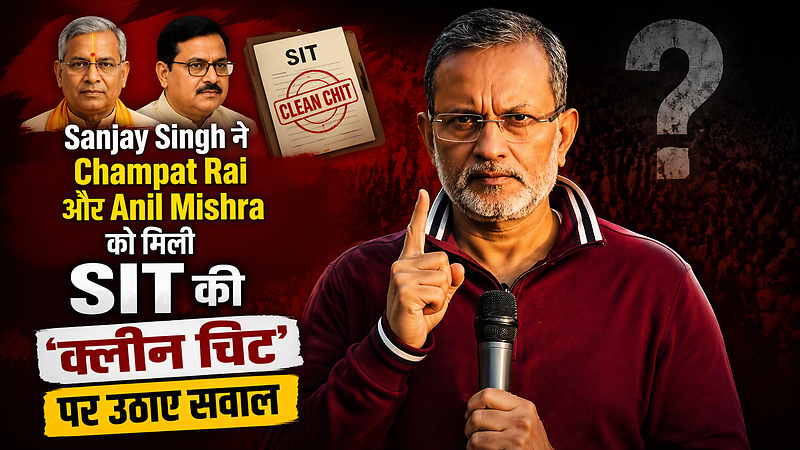
The recent decision by the Special Investigation Team (SIT) to clear Champat Rai and Anil Mishra of wrongdoing in the Ram Temple donation theft case has sparked intense debate among various commentators. Ajit Anjum, a prominent journalist, raises critical questions about the credibility of the SIT's findings. In his video, he highlights discrepancies in reports, pointing out that the Supreme Court has demanded a status report from the SIT, questioning how a clean chit could be issued when the investigation is ongoing. He asserts, 'How can Champat Rai and Anil Mishra be exonerated when they are the main accused in significant financial irregularities?' Anjum emphasizes that he has submitted documents showing inflated land prices linked to these individuals, suggesting that the SIT's conclusions lack transparency.
Further complicating the narrative, Anjum discusses the implications of procedural failures in the SIT's investigation. He argues that the SOP (Standard Operating Procedure) set up by the Ram Mandir Trust and the State Bank of India was not followed, leading to 'deliberate negligence' that created opportunities for theft. He notes, 'This was not just a technical error but a conscious oversight that allowed embezzlement to occur.' This sentiment is echoed by other voices in the debate, such as Supriya Shrinate, who contends that the hastily formed SIT is merely a facade to distract the public from the real issues. She claims, 'The SIT has done nothing to investigate the main suspects, and instead, it targets minor players in this scandal.'
Adding to the chorus of criticism, Neha Singh Rathore expresses skepticism about the SIT's approach, arguing that the investigation seems designed to shield higher officials while scapegoating lower-level operatives. She remarks, 'This investigation is suspicious; only a fraction of the stolen funds has been recovered, suggesting that the true culprits remain untouched.'
Meanwhile, Faye D'Souza calls for a court-monitored investigation, emphasizing the betrayal of trust felt by devotees who donated to the temple. She notes that the SIT's report was filed after the FIR, which is contrary to standard investigative procedures, raising further questions about the integrity of the inquiry.
In contrast, Nripendra Mishra, who is associated with the temple trust, dismisses the SIT as ineffective, asserting that the investigation is unlikely to yield significant results. He states, 'The SIT is a joke; expecting them to resolve this in 15 days is unrealistic.' This sentiment reflects a broader frustration with the perceived ineffectiveness of the SIT's inquiry.
As the debate unfolds, key figures like Sagarika Ghose from the Trinamool Congress join the fray, advocating for a more rigorous, transparent investigation. She insists that the SIT's findings need to be scrutinized under judicial oversight, arguing that the current inquiry lacks accountability. Ghose states, 'If this were an opposition party in power, the investigation would be much more thorough.'
The discourse surrounding the SIT's clean chit to Champat Rai and Anil Mishra reveals deep divisions among commentators, with calls for accountability and transparency clashing with defenses of the SIT's actions. As more evidence emerges, the public remains eager for clarity in a case that has captured national attention.