Smear or Scrutiny? The Divisive Campaign Against CJP
Sep 25, 2026, 03:30 IST
Summary
The debate on the campaign against Citizens for Justice and Peace (CJP) reveals stark divisions. Ajit Anjum highlights political scrutiny of CJP's founder, while critics like Shehzad Poonawala argue the group exploits public anger. Sanjay Dixit and Sandeep Deo raise concerns over anti-India elements and paid media campaigns. The discourse reflects a broader struggle for justice and dissent in India.
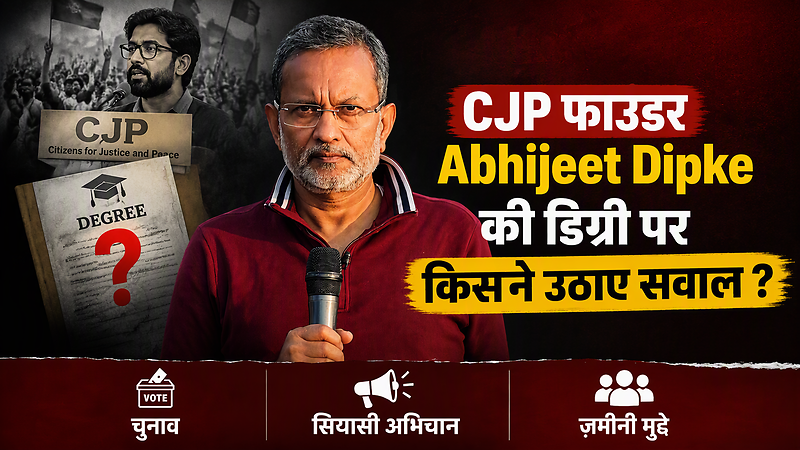
The debate surrounding the campaign against the Citizens for Justice and Peace (CJP) has sparked contrasting opinions among various content creators. On one side, Ajit Anjum, a prominent journalist, highlights a troubling trend where a BJP worker filed a Right to Information (RTI) request regarding the educational qualifications of CJP founder Abhijeet Dipke. Anjum argues, 'I am ready to show my scholarship and education loan letters, but will your leaders show their genuine degrees?' This raises questions about the legitimacy of the scrutiny directed at CJP amid broader political motives.
In a different vein, Anjum also addresses the extreme rhetoric surrounding CJP protests, noting that children participating in these demonstrations were labeled as terrorists. He asserts that those in high government positions, whom he describes as 'terrorists,' are the real perpetrators, while the students are simply seeking justice. This sentiment echoes in the words of popular YouTuber Sanjay Dixit, who claims that the protests signify a broader struggle for democracy and liberation, urging international support for the student movement.
Conversely, Kiren Rijiju, a member of the Aam Aadmi Party (AAP), connects the controversy to the political landscape, asserting that students should voice their concerns and engage in political discussions. This perspective highlights the importance of young leadership in shaping future narratives, contrasting with critics like Shehzad Poonawala, who argues that CJP exploits genuine public anger over issues like corruption for political gain.
The Jaipur Dialogues, represented by Sanjay Dixit, further critiques CJP, suggesting that their protests are backed by anti-India elements, with a warning that speaking out against the establishment could lead to imprisonment, as seen in the cases of Umar Khalid and Sharjeel Imam. This echoes sentiments from another creator, Sandeep Deo, who alleges that a media agency offered him ₹40,000 to create content negatively portraying student protests while praising the current government.
In response, Kumkum Binwal, a YouTuber, ridicules the so-called 'Cockroach Party,' claiming their main activity is to demand resignations without substantial action. He emphasizes that this party's criticism lacks substance, especially in light of the student protests that have drawn attention to significant issues.
Saurabh Shukla, another content creator, questions why CJP continues to engage with media channels that have previously marginalized their protests, suggesting that such interactions could undermine their credibility. He raises concerns about the motivations behind these media engagements, echoing the frustration of many independent journalists who feel the narrative surrounding CJP has been unfairly skewed.
As the debate unfolds, the intersection of politics, media, and student activism reveals deep divisions in public perception. The contrasting views highlight a struggle not only for justice but also for the right to dissent in a politically charged environment. Whether the campaign against CJP is seen as a necessary scrutiny or a politically motivated smear remains a contentious issue, with implications for the future of activism in India.